Aglaia laxiflora
Miq.

President and Fellows of Harvard College

President and Fellows of Harvard College

President and Fellows of Harvard College
What to Eat
Edible parts: Fruit
Fruit - raw. The seeds are covered with a translucent, edible flesh (aril). The fruits are up to 60mm long and 35mm wide, containing up to 2 seeds.
Where to Find It
It is a tropical plant. It occurs in Borneo.
Asia, Indonesia, Malaysia, SE Asia,
How to Identify
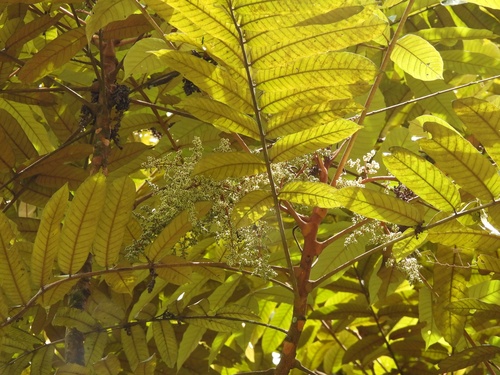
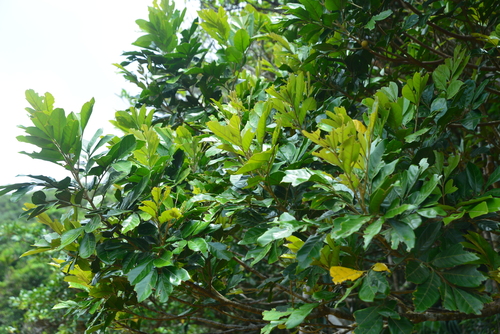
A small tree up to 25 m tall. The leaves are alternate and compound. The flowers are about 1 mm across. They are yellow and in large groups. The fruit are about 4 cm across. They are yellow to orange and are fleshy. The seeds have a layer around them that lets light through.
How to Grow
Trees can withstand temporary inundation of the soil. A dioecious species, both male and female forms need to be grown if fruit and seed are required.
Medicinal Uses
The genus 'Aglaia' is the only source of the group of about 50 known representatives of compounds that bear a unique cyclopenta[b]tetrahydrobenzofuran skeleton. These compounds are more commonly called rocaglate or rocaglamide derivatives, or flavaglines, and most have been found to have potent insecticidal properties, antifungal, antiviral, antibacterial or anthelmintic bioactivity. Several of them exhibit pronounced cytotoxic activity against a range of human cancers. Since the first representative in this group was only discovered in 1982, this is one of the few recent examples of a completely new class of plant secondary metabolites of biological promise (see B. G. Wang et al., Biochem. Syst. Ecol. 32: 1223-1226. 2004; L.W. Chaidir et al., J. Nat. Prod. 64: 1216-1220. 2001).
Other Uses
The genus 'Aglaia' is the only source of the group of about 50 known representatives of compounds that bear a unique cyclopenta[b]tetrahydrobenzofuran skeleton. These compounds are more commonly called rocaglate or rocaglamide derivatives, or flavaglines, and most have been found to have potent insecticidal properties, antifungal, antiviral, antibacterial or anthelmintic bioactivity. Several of them exhibit pronounced cytotoxic activity against a range of human cancers. Since the first representative in this group was only discovered in 1982, this is one of the few recent examples of a completely new class of plant secondary metabolites of biological promise (see B. G. Wang et al., Biochem. Syst. Ecol. 32: 1223-1226. 2004; L.W. Chaidir et al., J. Nat. Prod. 64: 1216-1220. 2001).
Wikipedia
Source ↗Aglaia laxiflora is a tree species in the family Meliaceae. It is native to Borneo, excluding the region that is the Malaysian state of Sarawak, an island located north of Australia at the geographic centre of Maritime Southeast Asia and is divided between the countries of Brunei Darussalam, Indonesia and Malaysia. Aglaia laxiflora is primarily restricted to forest and to periodically inundated dipterocarp forest. The tree is considered a vulnerable species as its habitat is continuously lost.
Names & Synonyms
Bako, Embunjau. Katitwar, Lantupak, Pejau, Penjeha
References (1)
- Slik, F., www.asianplant.net