Ardisia pterocaulis
Miq.
PrimulaceaeFruit

gbif · cc0
President and Fellows of Harvard College
President and Fellows of Harvard College

gbif · cc0
President and Fellows of Harvard College
President and Fellows of Harvard College
What to Eat
Edible parts: Fruit
The fruit is eaten.
Where to Find It
It is a tropical plant.
Asia, Indonesia, Malaysia, SE Asia,
Countries: United Arab Emirates, Afghanistan, Armenia, Azerbaijan, Bangladesh, Bahrain, Brunei, Bhutan, China, Georgia, Indonesia, Israel, India, Iraq, Iran, Jordan, Japan, Kyrgyzstan, Cambodia, North Korea, South Korea, Kuwait, Kazakhstan, Laos, Lebanon, Sri Lanka, Myanmar, Mongolia, Maldives, Malaysia, Nepal, Oman, Philippines, Pakistan, Qatar, Saudi Arabia, Singapore, Syria, Thailand, Tajikistan, Timor-Leste, Turkmenistan, Turkey, Taiwan, Uzbekistan, Vietnam, Yemen
How to Identify
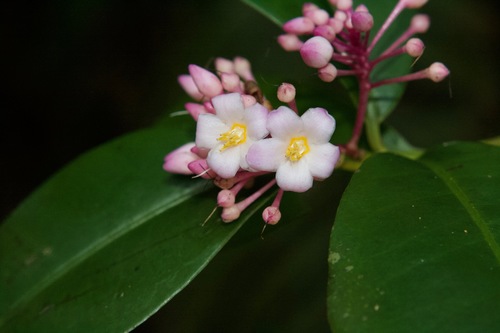
A shrub. It grows 8 m tall. The twigs have wings. The leaves are alternate and simple. The leaves have hairs underneath. The flowers are about 2 mm across and are pale pink. They are in groups. The fruit are 3 mm across. They are fleshy and white to pink.
How to Grow
Species in this genus generally prefer a well-drained humus rich soil in partial shade in a position sheltered from cold drying winds.
Notes
Also put in the family Myrsinaceae.
Names & Synonyms
Marburung, Pari
Ardisia platyclada King & GambleArdisia pterocaulis var. elongata Scheff.Ardisia pterocaulis var. nitida Scheff.Ardisia synneura Scheff.Tapeinosperma synneura (Scheff.) Philipson
References (1)
- Slik, F., www.asianplant.net