Dacryodes macrocarpa
(King) H. J. Lam
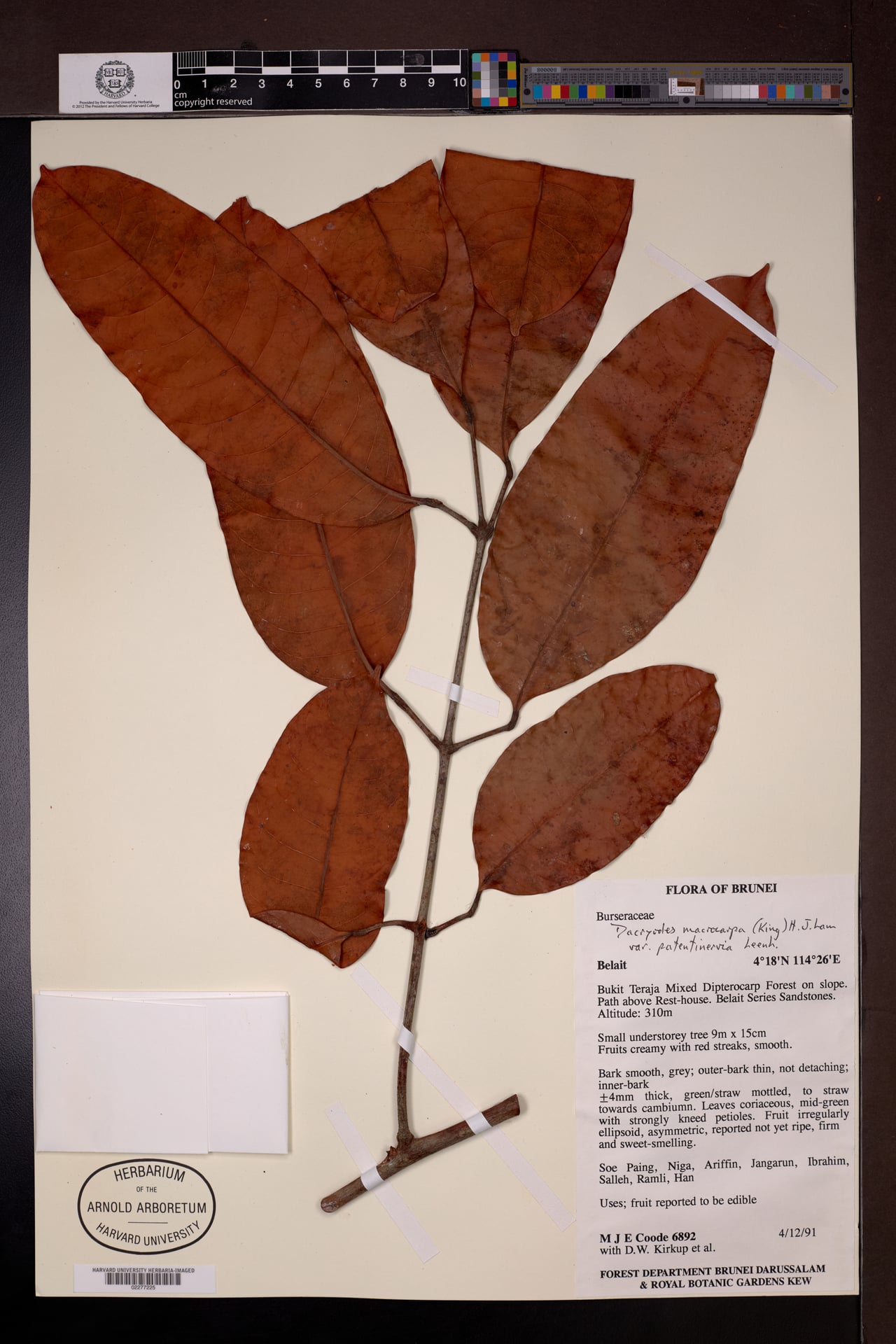
President and Fellows of Harvard College

President and Fellows of Harvard College

President and Fellows of Harvard College
What to Eat
Edible parts: Fruit
Fruit. The fruit is a fleshy drupe up to 30mm long. The flesh of the fruits in this genus usually adheres very strongly to the seed. When placed in hot (but not boiling) water at around 60 - 85°c the fruit softens and swells and all the flesh then slides easily off the seed.
Where to Find It
It is a tropical plant. It grows in forests up to 1,200 m above sea level. It can be in swamps and on poor sandy soils.
Asia, Brunei, Indonesia, Malaysia, Philippines, SE Asia,
How to Identify
A tree. It grows 40 m tall. It has buttresses. The bark is reddish brown. It cracks. The leaves are alternate and compound. There are 1-2 pairs of leaflets. The leaflets are 6012 cm long by 3-6 cm wide. The flowers are in groups in the axils of the leaves. The flowers are 5 mm across. They are in broad clusters. The fruit is 3 cm long. It is fleshy.
How to Grow
A dioecious species, both male and female forms need to be grown if fruit and seed are required.
Other Uses
The wood is used for construction.
Wikipedia
Source ↗Dacryodes macrocarpa is a tree in the family Burseraceae. The specific epithet macrocarpa is from the Greek meaning 'large fruit'.
Names & Synonyms
Asam, Asam asam, Asem, Kambasina, Karawas burong, Luring, Medang lada, Medang talsak, Paoh-paoh, Rarawa pipit. Seladah
References (3)
- Slik, F., www.asianplant.net
- Soepadmo, E. & Wong, K. M., (Eds.), 1995, Tree Flora of Sabah and Sarawak. Volume One. ITTO, Govt. Malaysia. p 69
- Sosef, M. S. M., Hong, L. T., & Prawirohatmodjo, S., (Eds.), 1998, Timber tree: Lesser-known timbers. Plant Resources of South-East Asia, 5(3), p 174


