Commiphora kataf
(Forssk.) Engl.
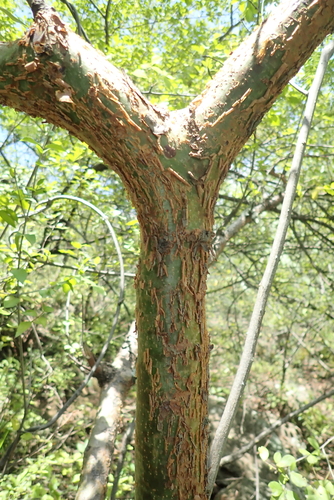
(c) Odile Weber, some rights reserved (CC BY-NC), uploaded by Odile Weber
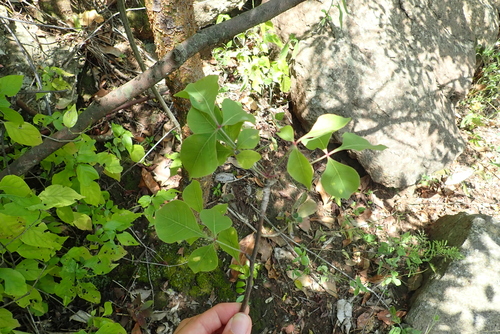
(c) Odile Weber, some rights reserved (CC BY-NC)
What to Eat
Edible parts: Leaves, Fruit
The leaves are boiled and drunk as a tea or coffee substitute. The fruit and leaves are both eaten. It serves as a famine food.
Where to Find It
It is a tropical plant. It grows between 75-1,650 m above sea level.
Africa, Djibouti, East Africa, Ethiopia, Kenya, Middle East, Saudi Arabia, Somalia, Sudan, Tanzania, Yemen,
How to Identify
A small tree. It grows 8 m tall. The bark is white to yellow and smooth and peels in papery flakes. The leaves have 3 leaflets. They are 1-7 cm long by 0.3-6 cm wide. The fruit is oval and 8-16 mm long by 8-13 mm wide.
How to Grow
A plant of semi-arid areas in the tropics, where it is found at elevations from near sea level to over 1,500 metres. Requires a sunny position and a well-drained soil. The plant can be pollarded or coppiced.
Propagation: Seed - Cuttings.
Medicinal Uses
The resin is used to treat stomach disorders. The plant is used medicinally. No more information is given.
Other Uses
The stems are probably a source of the gum resin 'Bursa Opopanax', which is used in perfumery, as an incense and as an insecticide.
Wikipedia
Source ↗Commiphora kataf is a species of flowering plant in the family Burseraceae, native to northeastern and eastern tropical Africa, and the southwestern Arabian Peninsula. A relative of myrrh, local peoples plant this shrubby tree as a resinous hedge that repels wildlife.
Other Information
It is a famine food.
Names & Synonyms
Kahatta-ata, Katata
References (6)
- Addis, G., Asfaw, Z & Woldu, Z., 2013, Ethnobotany of Wild and Semi-wild Edible Plants of Konso Ethnic Community, South Ethiopia. Ethnobotany Research and Applications. 11:121-141
- Addis, G., et al, 2013, The Role of Wild and Semi-wild Edible Plants in Household Food Sovereignty in Hamer and Konso Communities, South Ethiopia. Ethnobotany Research & Applications. 11:251-271
- Lulekal, E., et al, 2011, Wild edible plants in Ethiopia: a review on their potential to combat food insecurity. Afrika Focus - Vol. 24, No 2. pp 71-121
- Mutie, F. M., et al, 2023, Important Medicinal and Food Taxa (Orders and Families) in Kenya, Based on Three Quantitative Approaches. Plants 2023, 12, 1145
- Ocho, D. L., et al, 2012, Assessing the levels of food shortage using the traffic light metaphor by analyzing the gathering and consumption of wild food plants, crop parts and crop residues in Konso, Ethiopia. Journal of Ethnobiology and Ethnomedicine 8:30
- World Checklist of Useful Plant Species 2020. Royal Botanic Gardens, Kew


