Aristida setacea
Retz.
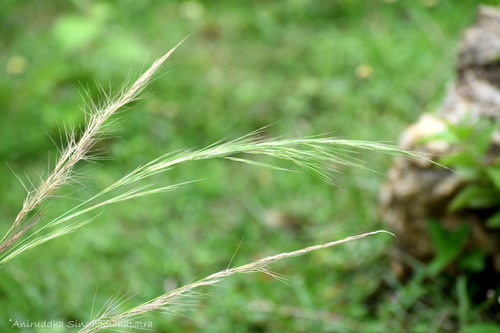
iNaturalist · cc-by-nc
(c) Aniruddha Singhamahapatra, some rights reserved (CC BY-NC), uploaded by Aniruddha Singhamahapatra
(c) Aniruddha Singhamahapatra, some rights reserved (CC BY-NC), uploaded by Aniruddha Singhamahapatra

iNaturalist · cc-by
(c) Augustin Soulard, some rights reserved (CC BY)
(c) Augustin Soulard, some rights reserved (CC BY)

iNaturalist · cc-by
(c) Augustin Soulard, some rights reserved (CC BY)
(c) Augustin Soulard, some rights reserved (CC BY)
What to Eat
Edible parts: Seeds, Cereal
The seeds are collected, cleaned, and cooked before eating and are used as a cereal. This plant serves as a famine food.
Known Hazards
Where to Find It
It is a tropical plant.
Asia, India, Myanmar, SE Asia,
Countries: United Arab Emirates, Afghanistan, Armenia, Azerbaijan, Bangladesh, Bahrain, Brunei, Bhutan, China, Georgia, Indonesia, Israel, India, Iraq, Iran, Jordan, Japan, Kyrgyzstan, Cambodia, North Korea, South Korea, Kuwait, Kazakhstan, Laos, Lebanon, Sri Lanka, Myanmar, Mongolia, Maldives, Malaysia, Nepal, Oman, Philippines, Pakistan, Qatar, Saudi Arabia, Singapore, Syria, Thailand, Tajikistan, Timor-Leste, Turkmenistan, Turkey, Taiwan, Uzbekistan, Vietnam, Yemen
How to Identify
A grass. It keeps growing from year to year. It grows in clumps. The stalks are erect and 50-120 cm tall. The leaf blades are 20-40 cm long by 2 mm wide. The flowers are in a branched group 15-40 cm long.
Other Information
It is a famine food.
Names & Synonyms
Thudaippam
Aristida quinqueseta Steud.Chaetaria setacea (Retz.) P. Beauv.
References (1)
- Tamil herbs, 2007, Edible Plants of the Tropical Dry Evergreen Forest.


