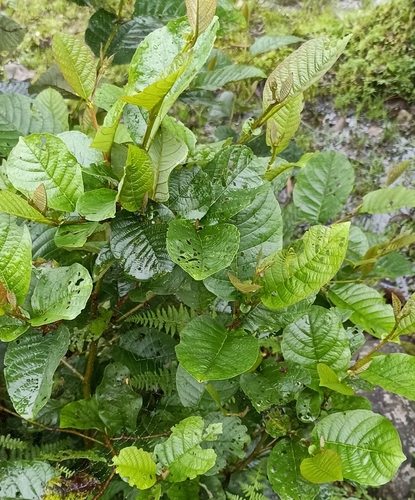
Alnus serrulata
(Aiton) Willd.
Hazel alder, Smooth alder

(c) Homer Edward Price, some rights reserved (CC BY)

(c) "<a href=""http://www.wli.nrcs.usda.gov"">NRCS National Wetland Team, Fort Worth, TX</a>.", some rights reserved (CC BY-NC-SA)

(c) Steven J. Baskauf, some rights reserved (CC BY)
What to Eat
Edible parts: tea, Possibly medicine
No edible uses are known for this plant.
Where to Find It
It is a temperate plant. It often grows near streams. It suits hardiness zones 5-8. Arboretum Tasmania.
Australia, North America, Tasmania, USA,
How to Identify
A shrub or small tree. It grows 2.5-4 m tall. The trunk is 15 cm across. The edges of the leaves have fine teeth.
How to Grow
Propagation: Seed is best sown in a cold frame as soon as it is ripe, covered only very lightly or not at all — spring-sown seed germinates equally well provided it is not covered. Germination occurs as temperatures rise in spring. Seedlings should be pricked out into individual pots once large enough to handle; if growth is sufficient they can go into their permanent positions in summer, otherwise overwinter them in pots outdoors and plant out the following spring. With larger quantities of seed, sow thinly in an outdoor seed bed in spring and plant out in autumn/winter, or grow on for a further season before transplanting. Cuttings of mature wood can be taken as soon as leaves fall in autumn and rooted outdoors in sandy soil.
Medicinal Uses
A tea brewed from the bark is analgesic, astringent, diuretic, emetic, and purgative, and is considered a blood purifier. It is used to treat diarrhoea, the pain of childbirth, coughs, toothache, and sore mouths. Externally, the bark tea serves as an eye wash and a topical wash for hives, poison ivy rash, piles, swellings, and sprains. A decoction made from the cones is also astringent.
Other Uses
The trees have extensive root systems and are sometimes planted along stream banks to prevent erosion. The wood is soft and brittle, weighing 29lb per cubic foot, and has little commercial value. This species is also noted for its role in food forests and as a nitrogen fixer.
Wikipedia
Source ↗Alnus serrulata, the hazel alder or smooth alder, is a thicket-forming shrub in the family Betulaceae. It is native to eastern North America and can be found from western Nova Scotia and southern New Brunswick south to Florida and Texas.
Notes
The bark is used as a tea for medicine.
Names & Synonyms
References (1)
- Jackes, D. A., Edible Forest Gardens