Polytrichum commune
Hedw.
Common haircap moss

(c) gaforestwatch, some rights reserved (CC BY-NC), uploaded by gaforestwatch
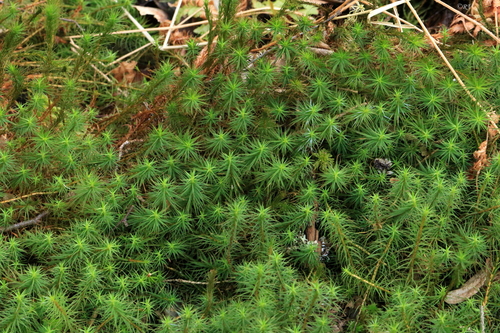
(c) Ramunė Vakarė, some rights reserved (CC BY-NC-SA), uploaded by Ramunė Vakarė

(c) Richard Carter, some rights reserved (CC BY-NC-SA)
What to Eat
Edible parts: Possibly not edible.
None known.
Where to Find It
It is a temperate plant. It suits hardiness zones 2-10.
Coming Soon
How to Identify
Slow-growing evergreen moss reaching 0.2 meters tall and 0.3 meters wide. Hardy to UK zone 3 with wind-pollinated reproduction. Adapts to sandy, loamy, clay, and nutrient-poor soils in acidic conditions. Tolerates full shade, light shade, or open sun, preferring moist or wet soil.
How to Grow
Prefers lightly shaded areas with moist slightly acidic soil, it can also survive in areas of full sunlight provided the soil is moist. Can also grow in areas of poor soil and slow drainage. A clumping mat former. Forming a dense prostrate carpet spreading indefinitely.
Propagation: Propagates by spores, which are released and dispersed by wind during summer.
Medicinal Uses
Some people make a tea from this moss to dissolve kidney and gallbladder stones.
Other Uses
This moss forms a low to medium density mat-forming groundcover suitable as an ornamental plant for shady, damp areas. Some people brew it into a tea to dissolve kidney and gallbladder stones. It has also been made into a tea used as a hair rinse to strengthen hair. The stems have been woven and used to make baskets.
Wikipedia
Source ↗Polytrichum commune (also known as common haircap, great golden maidenhair, great goldilocks, common haircap moss, or common hair moss) is a species of moss found in many regions with high humidity and rainfall. The species can be exceptionally tall for a moss with stems often exceeding 30 cm (12 in) and rarely reaching 70 cm (27.5 in), but it is most commonly found at shorter lengths of 5 to 10 cm (2 to 4 in). It is widely distributed throughout temperate and boreal latitudes in the Northern Hemisphere and also found in Mexico, several Pacific Islands including New Zealand, and also in Australia. It typically grows in bogs, wet heathland and along forest streams. Additionally, class Polytrichopsida has been shown to thrive in partially open habitats that have been recently disturbed by human activities or even livestock.
Names & Synonyms
Common haircap, great golden maidenhair, great goldilocks, common haircap moss, common hair moss
References (1)
- Jackes, D. A., 2007, Edible Forest Gardens