Euclea racemosa
L.
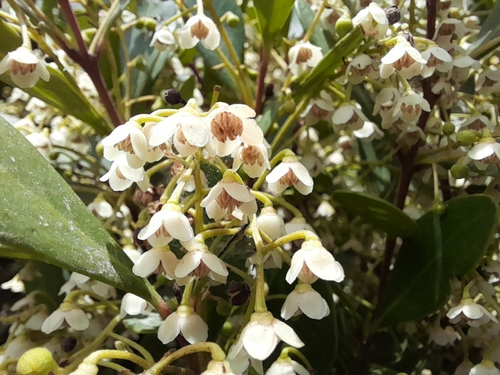
(c) Abdul-lateef Ismail, some rights reserved (CC BY-NC), uploaded by Abdul-lateef Ismail

(c) Adriaan Grobler, some rights reserved (CC BY-NC), uploaded by Adriaan Grobler
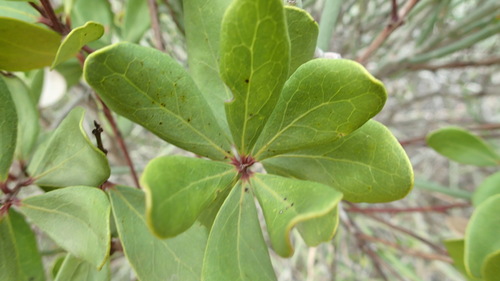
(c) Ann, some rights reserved (CC BY-NC), uploaded by Ann
What to Eat
Edible parts: Fruit
Edible fruit. The fruit is less than 1cm in diameter, it contains a single large seed surrounding a thin flesh.
Where to Find It
It is a subtropical plant. It grows from sea level to 1,500 m above sea level.
Africa, Comoros, Egypt, Ethiopia, Europe, Kenya, Middle East, Saudi Arabia, South Africa, Southern Africa, Turkey, Türkiye,
How to Identify
A shrub. It grows 2-3 m tall. The main stem can be 12 cm across. It has many branches. The branches are reddish and angular. The leaves can be alternate or opposite. They are oblong and rounded at the tip. The flowers are white and drooping. There are 4-13 flowers in a group. The fruit are round and black. There is one seed.
How to Grow
Plants can be coppiced. A dioecious species, both make and female forms need to be grown if fruit and seed are required.
Propagation: Seed - no pre-treatment is necessary. The seed stores well in air-tight containers at room temperature.
Medicinal Uses
The roots are purgative.
Other Uses
A black dye is obtained from the roots. The plant provides roofing material. No more details are given. The branches are used as tooth brushes. The wood is hard and heavy. It is sometimes employed by wheelwrights and turners, and also serves very well for wooden screws. It burns very well and so is chiefly used as fuel. A pioneer species used for reforestation and soil conservation. The tree is used as a live fence, and for marking boundaries. It responds well to trimming and makes a good dense hedge.
Wikipedia
Source ↗Euclea racemosa (the sea guarrie or dune guarrie) is a small to medium-sized evergreen tree that is indigenous to the Indian Ocean coast of Africa from Egypt to South Africa, as well as in Comoros, Oman and Yemen. Euclea racemosa has leathery foliage that can be exceptionally even and dense - making it an ideal plant for hedges. A dioecious tree (male and female flowers on separate trees), it produces small white flowers, which are followed by red, purple and black fruits that attract birds. The berries are used locally to make "Guarrie vinegar". The name guarrie appears to derive from the local Khoe language, in which it is spelled gwarri.
Names & Synonyms
Mi'essa, Seeghwarrie
References (8)
- De Vynk, J. C., et al, 2016, Indigenous edible plant use by contemporary Khoe-San descendants of South Africa's Cape South Coast. South African Journal of Botany. 102 (2016) 60-69
- Ferns, Useful Tropical Plants
- Mengistu, F. & Hager, H., 2008, Wild Edible Fruit Species Cultural Domain, Informant Species Competence and Preference in Three Districts of Amhara Region, Ethiopia. Ethnobotany Research & Applications 6:487-502
- Mutie, F. M., et al, 2023, Important Medicinal and Food Taxa (Orders and Families) in Kenya, Based on Three Quantitative Approaches. Plants 2023, 12, 1145
- Ruiters-Welcome, A. K., 2019, Food plants of southern Africa. Ph.D. thesis. Univ. of Johannesburg p 53
- Tropical Plants Database, Ken Fern. tropical.theferns.
- Welcome, A. K. & Van Wyk, B.-E., 2019, An inventory and analysis of the food plants of southern Africa. South African Journal of Botany 122 (2019) 136–179
- World Checklist of Useful Plant Species 2020. Royal Botanic Gardens, Kew


