Conopodium subcarneum
(Boiss. & Reut.) Boiss.
ApiaceaeRoots
iNaturalist · cc-by-nc-sa
(c) MDavid, some rights reserved (CC BY-NC-SA), uploaded by MDavid
(c) MDavid, some rights reserved (CC BY-NC-SA), uploaded by MDavid

iNaturalist · cc-by-nc
(c) Ángel Fernández Cancio, some rights reserved (CC BY-NC)
(c) Ángel Fernández Cancio, some rights reserved (CC BY-NC)

iNaturalist · cc-by-nc
(c) Ángel Fernández Cancio, some rights reserved (CC BY-NC)
(c) Ángel Fernández Cancio, some rights reserved (CC BY-NC)
What to Eat
Edible parts: Tubers, Root
The tubers are eaten raw, particularly by children.
Where to Find It
It is a Mediterranean plant.
Europe, Portugal, Spain,
Countries: Andorra, Albania, Austria, Bosnia & Herzegovina, Belgium, Bulgaria, Belarus, Switzerland, Cyprus, Czechia, Germany, Denmark, Estonia, Spain, Finland, France, United Kingdom, Greece, Croatia, Hungary, Ireland, Iceland, Italy, Liechtenstein, Lithuania, Luxembourg, Latvia, Monaco, Moldova, Montenegro, North Macedonia, Malta, Netherlands, Norway, Poland, Portugal, Romania, Serbia, Russia, Sweden, Slovenia, Slovakia, San Marino, Ukraine
How to Identify
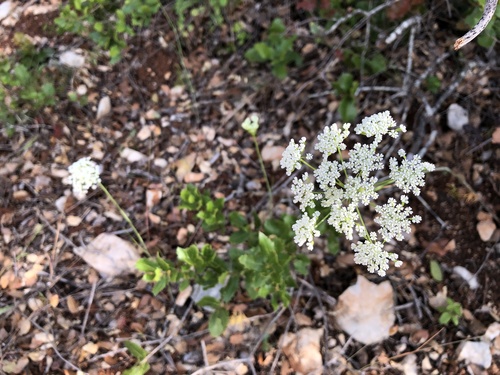
A Mediterranean herb of the carrot family (Apiaceae) valued for its underground tubers.
Other Information
They are eaten especially by children.
Names & Synonyms
Afrijones, Cacarrollas, Cacamochas, Criadillas, Macucos
Bunium subcarneum Boiss. & Reut.Conopodium brachycarpum Boiss. ex LangeConopodium brachycarpum var. pusillum MerinoConopodium capillifolium subsp. subcarneum (Boiss. & Reut.) Lainz
References (4)
- Gonzalez, J. A., et al, 2011, The consumption of wild and semi-domesticated edible plants in the Arribes del Duero (Salamanca-Zamora, Spain): an analysis of traditional knowledge. Genetic. Resour Crop Evolution 58:991-1006
- Pardo-de-Santayana, M., et al, 2005, The gathering and consumption of wild edible plants in the Campoo (Cantabria, Spain). International Journal of Food Sciences and Nutrition. 56(7): 529-542
- Pardo-de-Santayana, M., et al, 2007, Traditional knowledge of wild edible plants used in the northwest of the Iberian Peninsula (Spain and Portugal): a comparative study. Journal of Ethnobiology and Ethnomedicine 2007, 3:27
- Tardio, J., et al, Ethnobotanical review of wild edible plants in Spain. Botanical J. Linnean Soc. 152 (2006), 27-71