Catenella nipae
Zanardini
Catenella
iNaturalist · cc-by
(c) Javier, some rights reserved (CC BY), uploaded by Javier
(c) Javier, some rights reserved (CC BY), uploaded by Javier

iNaturalist · cc-by-nc
(c) Zachary Robertson, some rights reserved (CC BY-NC)
(c) Zachary Robertson, some rights reserved (CC BY-NC)

iNaturalist · cc-by-nc
(c) Zachary Robertson, some rights reserved (CC BY-NC)
(c) Zachary Robertson, some rights reserved (CC BY-NC)
What to Eat
Edible parts: Algae, Frond, Seaweed
The seaweed is eaten raw or cooked. When boiled it becomes rubbery in texture.
Where to Find It
A tropical plant. It is associated with mangroves. It can be in shaded places on rocky shores.
Asia, Australia, Bangladesh, East Africa, India, Indochina, Indonesia, Malaysia, Myanmar, New Zealand, Papua New Guinea, PNG, Philippines, SE Asia, Singapore, South Africa, Southern Africa, Tanzania, Vietnam,
Countries: United Arab Emirates, Afghanistan, Armenia, Australia, Azerbaijan, Bangladesh, Bahrain, Burundi, Brunei, Bhutan, Botswana, China, Djibouti, Eritrea, Ethiopia, Georgia, Indonesia, Israel, India, Iraq, Iran, Jordan, Japan, Kenya, Kyrgyzstan, Cambodia, Comoros, North Korea, South Korea, Kuwait, Kazakhstan, Laos, Lebanon, Sri Lanka, Lesotho, Madagascar, Myanmar, Mongolia, Mauritius, Maldives, Malawi, Malaysia, Mozambique, Namibia, Nepal, Oman, Papua New Guinea, Philippines, Pakistan, Qatar, Rwanda, Saudi Arabia, Seychelles, Singapore, Somalia, South Sudan, Syria, Eswatini, Thailand, Tajikistan, Timor-Leste, Turkmenistan, Turkey, Taiwan, Tanzania, Uganda, Uzbekistan, Vietnam, Yemen, South Africa, Zambia, Zimbabwe
How to Identify
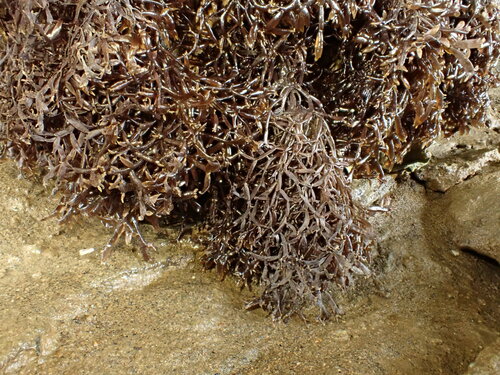
A seaweed. It is an irregularly branched plant. The branches can be cylinder shaped or flattened. It narrows at the base of each branch. It forms clumps on mangrove roots. It is grey-brown or purple-black.
References (7)
- Boergesen, F., 1938, Catenella nipae used as food in Burma. Journal of Botany 76:265-70
- Cribb, A.B. & J.W., 1976, Wild Food in Australia, Fontana. p 190
- Cribb, A.B., 1996, Seaweeds of Queensland A Naturalist's Guide. The Queensland Naturalists' Club Handbook No. 2. p 73
- Crowe, A., 1997, A Field Guide to the Native Edible Plants of New Zealand. Penguin. p 145
- Kiple, K.F. & Ornelas, K.C., (eds), 2000, The Cambridge World History of Food. CUP p 236
- Millar, A. J., et al, 1999, Annotated and Illustrated Survey of the Marine Macroalgae from Motupore Island and Vicinity (Port Moresby area, Papua New Guinea). 111. Rhodophyta. Australian Systematic Botany 12, 549-591
- www.algaebase/org