Sarcosoma globosum
(Schmidel) Rehm

(c) jonas_barzdenas, some rights reserved (CC BY-NC)
(c) Eugene Popov, some rights reserved (CC BY), uploaded by Eugene Popov

(c) sjhopkins, some rights reserved (CC BY-NC)
What to Eat
Edible parts: Mushroom, Fungus
Where to Find It
It is a tropical plant.
Africa, Cameroon, Central Africa,
How to Identify
A tropical mushroom in the Sarcosomataceae family.
Wikipedia
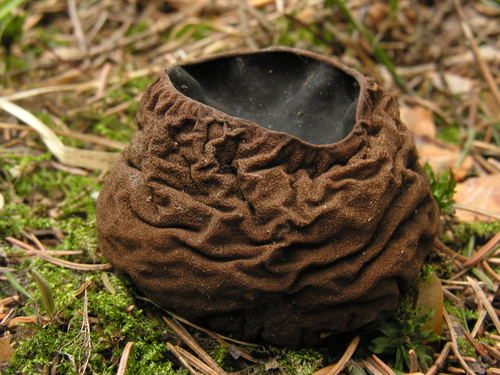
Source ↗Sarcosoma globosum, or witches cauldron, is a species of fungus in the family Sarcosomataceae. It was first described in 1793 by Casimir Christoph Schmidel. Johann Xaver Robert Caspary transferred it to the genus Sarcosoma in 1891. Also known as the charred-pancake cup, it is a near-threatened fungus native to Northern Europe. It is rarely found in some parts of northeastern North America, particularly in the Great Lakes region. To biologists' surprise, in 2021 it was found in Northern British Columbia. The witches cauldron is an ascomycete or sac fungus, meaning that its microscopic structure utilizes the ascus, a spore-bearing cell, for sexual reproduction. It is a detritivore, and survives on decomposing plant matter, most commonly leaf litter. It is found in spruce forests and does not currently have any human uses.
Names & Synonyms
Lenteleminko'o, Nyeng
References (1)
- van Dijk, H., et al, 2003, Knowledge and Utilization of Edible Mushrooms by Local Populations of the Rain Forest of South Cameroon. Ambio Vol. 32, No. 1.pp 19-23