Ribes malvaceum
Sm.
Chaparral current
no rights reserved

(c) Dan Fitzgerald (Fitz), some rights reserved (CC BY-NC), uploaded by Dan Fitzgerald (Fitz)
no rights reserved
What to Eat
Edible parts: Fruit
The purple, globose fruit can be eaten raw or cooked and is considered palatable. Fruits are around 6–7mm in diameter. Currants are generally harvested in mid to late summer depending on the species and local climate, with flowering typically occurring in spring before or as the leaves emerge.
Where to Find It
It is a warm temperate plant. It grows in mountain slopes and hillsides.
Mexico, North America, USA,
How to Identify
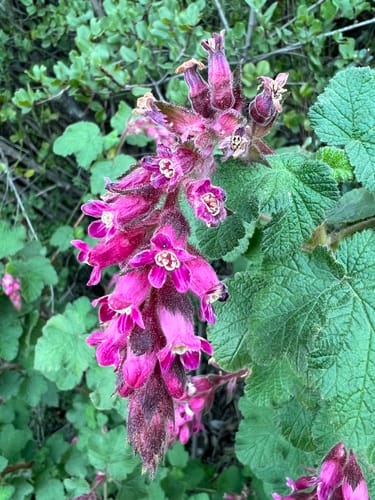
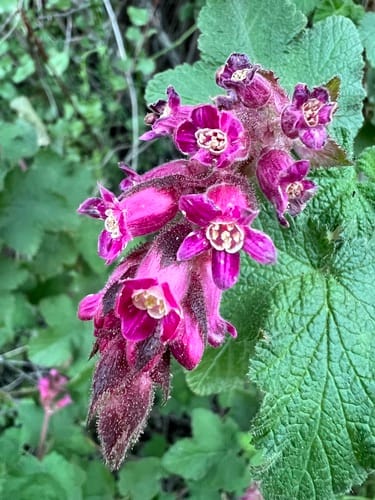
A shrub. It grows 2 m tall. It does not have thorns. The leaves have soft grey hairs underneath. The leaves are 5 cm across and have 3 lobes. They are dull green. The flowers are pink or purple in hanging groups. The fruit are purple to black and sticky.
How to Grow
Soil Texture: Prefers light (sandy) to medium soils. It can tolerate rocky or gravelly soils commonly found in chaparral habitats. Soil Moisture: Thrives in dry to moderately moist soils. It is drought-tolerant once established and adapted to seasonal rainfall patterns typical of Mediterranean climates. Drainage: Requires well-drained soil to prevent root rot. Soil pH: Tolerates a range of soil pH levels, from slightly acidic to neutral. Saline Tolerance: Low tolerance for saline conditions; best suited for inland and upland areas rather than coastal environments with high salinity. Tolerance of Poor Soil: it can thrive in poor, nutrient-deficient soils, particularly in natural chaparral and woodland habitats. Light Requirements: Grows best in full sun to partial shade. Tolerates shade better in hotter climates. Height: Typically grows to about 1–2 meters (3–6 feet) tall, with a spread of about 1.5–2 meters (5–7 feet). Pollination: bees, hummingbirds, and other insects are attracted to its clusters of fragrant, tubular pink to red flowers. Temperature: Native to California and suited for USDA zones 7–10. It thrives in Mediterranean climates with hot, dry summers and mild, wet winters. Drought Tolerance: Very drought-tolerant once established, making it ideal for xeriscaping. Flowering: Produces showy clusters of pink to red flowers in late fall to early spring, providing a vital nectar source for pollinators during winter. Pests and Diseases: Generally pest-resistant but can be susceptible to powdery mildew in overly humid or poorly ventilated conditions. Pruning: Minimal pruning is needed; trimming dead or weak branches after flowering can promote healthy growth.A deciduous shrub with erect stems. It can grow 100 - 200cm tall. The plant is harvested from the wild for local use as food. Species in this genus are generally easy to grow, preferring a position in the sun (where they fruit best) or moderate shade and succeeding in most moist but well-drained soils of at least moderate fertility. White pine blister rust, caused by the pathogen Cronartium ribicola, is a fungal disease native to Asia. It has spread via human activity to many other regions, where it has become more virulent. It has a complex life cycle requiring currants (Ribes species) and white pines (Pinus species of the section Strobus) for the disease to spread. While Ribes species can generally live with the disease (it has an annual life cycle and infects the leaves only), Pinus species can be devastated by it (it becomes perennial and spreads through the tree). Young pines are far more susceptible than mature trees. In America, the growing of certain Ribe species is banned in some areas to protect plantations of white pine species. Plants in this genus tend to be notably susceptible to honey fungus. The native range of this species is from California to Mexico (N. Baja California). It is a shrub and grows primarily in the subtropical biome. Currant plants are relatively fast-growing, reaching maturity in about 2 to 3 years. They typically grow to a height of 1 to 2 meters (3 to 6 feet) and can be quite productive.Currants are usually harvested in mid to late summer, from June to August (Northern Hemisphere), depending on the species and local climate. Ribes species generally flower in spring, around April to June (Northern Hemisphere) , with flowering occurring before or as the leaves emerge.
Propagation: Seed is best sown as soon as it is ripe in autumn in a cold frame. Stored seed requires 3 months of cold stratification at 0–9°C and should be sown as early in the year as possible. Under typical storage conditions, seed can remain viable for 17 years or more. Prick out seedlings into individual pots when large enough to handle, grow on in a cold frame for their first winter, then plant out in late spring the following year. Take cuttings of half-ripe wood in mid-summer in a frame. Cuttings of mature wood of the current year's growth, preferably with a heel of the previous year's growth, can be taken from late autumn to late winter in a cold frame or sheltered bed outdoors.
Medicinal Uses
None known.
Other Uses
Currants can be incorporated into agroforestry systems as a shrub layer within mixed-species plantings. They attract pollinators and beneficial insects, and their dense growth provides habitat for wildlife, making them well suited to native plant gardens, erosion control on slopes, and wildlife gardens. Their winter flowering also makes them a notable ornamental in Mediterranean gardens. The flowers are rich in nectar and pollen, attracting bees and other beneficial insects. The berries provide food for birds and small mammals, while the dense shrubs offer cover, shelter, and nesting sites for wildlife. Leaf litter and dense growth create overwintering sites and shelter for invertebrates, and the plants contribute to ground cover.
Wikipedia
Source ↗Ribes malvaceum, the chaparral currant, is a gooseberry species native to the Californias.
Names & Synonyms
Chaparral Currant
References (1)
- Segura, S., et al, 2018, The edible fruit species in Mexico. Genet Resour Crop Evol (2018) 65:1767–1793
More from Grossulariaceae


