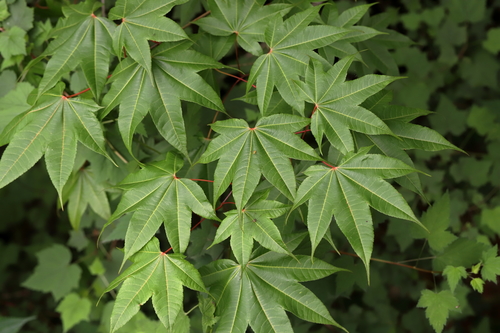
Aesculus assamica
Griff.
Ma niang nam

no rights reserved, uploaded by Jean-Paul Boerekamps

(c) Vijay Anand Ismavel, some rights reserved (CC BY-NC)

(c) basilb, some rights reserved (CC BY-NC), uploaded by basilb
What to Eat
Edible parts: Fruit
The young fruit are eaten.
Where to Find It
It is a tropical plant. It grows in limestone country. It is in wet forests and mixed or evergreen broad-leaved forests. It grows between 100-2,000 m above sea level in S China. In Yunnan.
Asia, Bangladesh, Bhutan, Himalayas, India, Indochina, Laos, Myanmar, Northeastern India, SE Asia, Thailand, Vietnam,
How to Identify
A tree. It grows 32 m tall. The trunk is 60 cm across. The leaves have 5-9 leaflets. These are 12-35 cm long by 5-18 cm wide. There can be teeth along the edge. The flowers are in groups of 3-11 flowers and they have a scent. The petals are white or yellow. The fruit is a capsule that is oval and 5 cm long by 3-8 cm wide. There is usually one seed.
Medicinal Uses
It is used in traditional medicine for treatment of inflammation and as an antifungal agent, and is being investigated for treatment of skin infections. It has been introduced into cultivation in Europe in Britain, and in France where a 15 year old specimen had reached 7.6 m tall.
Wikipedia
Source ↗Aesculus assamica (syn. Aesculus wangii), the Assam horse-chestnut, is a widespread species of flowering plant in the genus Aesculus in the family Sapindaceae. It is native to warm temperate to subtropical areas of the eastern Himalayas from Sikkim through Bhutan and Assam to Arunachal Pradesh, and southwestern and southern China (including the far southeast of Tibet), Bangladesh, and mainland southeast Asia, except Cambodia and Peninsular Malaysia.
Notes
Also put in the family Hippocastanaceae.
Names & Synonyms
Kataw-chying-hkrang, Pun-pan, Wesinni, Yamyaw
References (1)
- Thitiprasert, W., et al, 2007, Country report on the State of Plant Genetic Resources for Food and Agriculture in Thailand (1997-2004). FAO p 95