Pilea microphylla
(L.) Liebm.
Rockweed
(c) James Bailey, some rights reserved (CC BY-NC), uploaded by James Bailey

no rights reserved

no rights reserved
What to Eat
Edible parts: Leaves - spice, Plant - spice, Plant - tea
The leaves are eaten raw and can be used as a spice or prepared as a tea.
Known Hazards
Where to Find It
It is a tropical plant. In Ecuador it grows between sea level and 3,500 m above sea level. It is often in shady areas and near water. It can survive in dry places. In Argentina it grows below 500 m above sea level.
Africa, American Samoa, Argentina, Asia, Brazil, British Indian Ocean Terr., BIOT, Caroline Islands, China, Dominican Republic, Ecuador, Fiji, Guinea, Guinée, Guinea-Bissau, Indochina, Kiribati, Laos, Maldives, Marquesas, Mexico, Nauru, Niue, Pacific, Rotuma, Samoa, Sao Tome and Principe, South America*, SE Asia, Tuvalu, Vanuatu, Wallis and Futuna, West Africa, West Indies,
How to Identify
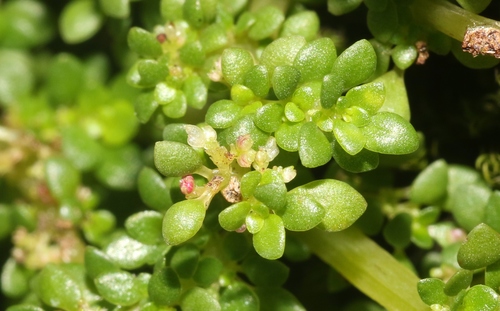
A herb that grows each year from seed. It is a creeping plant. The stems are branched. The leaves are very small and fleshy. They are round and 2-3 mm across. The flowers are white and of one sex. They form groups in the axils of the leaves. There are only a few flowers. The fruit is small and has one seed.
How to Grow
Prefers a position in partial shade. Requires a moist but well-drained soil, and can tolerate short periods of soil inundation. Tolerant of a range of soil types. Male flowers explosively discharge pollen into the air, hence one of the common names for this plant of 'artillery plant'.
Propagation: Seed - Stem tip cuttings root easily.
Medicinal Uses
An infusion of the entire plant is used as a diuretic. The crushed leaves are applied commonly to sores and bruises to heal them.
Other Uses
In its native habitat, the plant may spread to as much as 60cm wide and is sometimes massed in tropical gardens as a ground cover.
Wikipedia
Source ↗Pilea microphylla, also known as angeloweed, artillery plant, joypowder plant, or (in Latin America) brilhantina, is an annual plant native to Florida, Mexico, the West Indies, and tropical Central and Southern America. In the southern part of México, specifically Campeche and Mérida, the local name is frescura. The plant belongs to the family Urticaceae. It has light green, almost succulent, stems and tiny leaves. It is grown as a ground cover in many areas.
Other Information
It is sold in local markets in China.
Names & Synonyms
Artillery plant, Gunpowder plant, Mariyan hui, Paquixiuitl, Reh, Sassa, Siempre viva, Tou ming
References (11)
- Cabalion, P. and Morat, P., 1983, Introduction le vegetation, la flore et aux noms vernaculaires de l'ile de Pentcoste (Vanuatu), In: Journal d'agriculture traditionnelle et de botanique appliquee JATBA Vol. 30, 3-4
- Flora of China @ efloras.org Volume 5
- Li, D. et al, 2017, Ethnobotanical survey of herbal tea plants from the traditional markets in Chaoshan, China. Journal of Ethnopharmacology. 205 (2017) 195-206
- Parham, B. E. V., 1972, Plants of Samoa. New Zealand Department of Scientific and Industrial Research. Information Series. No. 85 p 122
- Pena, F. B., et al, 1998, Los quelites de la Sierra Norte de Puebla, Mexico: Inventory Y Formas de Preparacion. Bol. Soc. Bot. Mexico 62:49-62
- Quintana, C. M., 2010, Wild Plants in the Dry Valleys Around Quito Ecuador. An Illustrated Guide. Publicationes del Harbario, QCA p 192
- Sujanapal, P., & Sankaran, K. V., 2016, Common Plants of Maldives. FAO & Kerala FRI, p 208
- Thaman, R. R., 1987, Plants of Kiribati: A listing and analysis of vernacular names. Atoll Research Bulletin No. 296
- Thaman, R. R, 2016, The flora of Tuvalu. Atoll Research Bulletin No. 611. Smithsonian Institute p 116
- Topp, J. M. W., 1988, An Annotated Check List of the Flora of Diego Garcia, British Ocean Territory. Atoll Research Bulletin No. 313
- Yuncker, T. G., 1943, The Flora of Niue Island. Bernice P. Bishop Museum Bulletin 178 p 49


