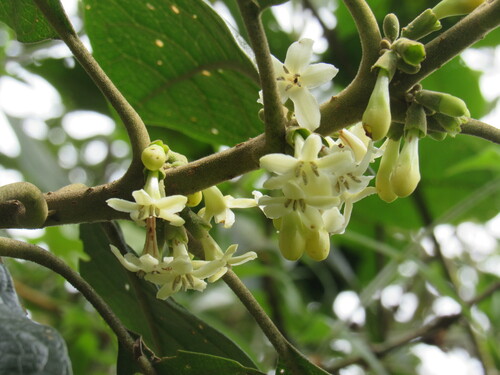
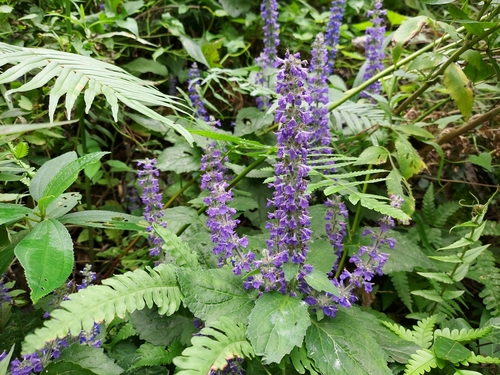
Ajuga macrosperma
Wall. ex Benth.
Bugle
iNaturalist · cc-by-nc
(c) Phuentsho, some rights reserved (CC BY-NC), uploaded by Phuentsho
(c) Phuentsho, some rights reserved (CC BY-NC), uploaded by Phuentsho

iNaturalist · cc-by-nc
(c) 通通, some rights reserved (CC BY-NC)
(c) 通通, some rights reserved (CC BY-NC)

iNaturalist · cc-by-nc
(c) MP Zhou, some rights reserved (CC BY-NC)
(c) MP Zhou, some rights reserved (CC BY-NC)
What to Eat
Edible parts: Leaves, Vegetable
The leaves are used as a potherb and vegetable.
Where to Find It
It is a tropical and subtropical plant. It grows in shady areas and in limestone forests between 400-2,600 m above sea level. In Yunnan.
Asia, Bangladesh, Bhutan, China, Himalayas, India, Indochina, Laos, Myanmar, Nepal, Northeastern India, SE Asia, Taiwan, Thailand, Vietnam,
Countries: United Arab Emirates, Afghanistan, Armenia, Azerbaijan, Bangladesh, Bahrain, Brunei, Bhutan, China, Georgia, Indonesia, Israel, India, Iraq, Iran, Jordan, Japan, Kyrgyzstan, Cambodia, North Korea, South Korea, Kuwait, Kazakhstan, Laos, Lebanon, Sri Lanka, Myanmar, Mongolia, Maldives, Malaysia, Nepal, Oman, Philippines, Pakistan, Qatar, Saudi Arabia, Singapore, Syria, Thailand, Tajikistan, Timor-Leste, Turkmenistan, Turkey, Taiwan, Uzbekistan, Vietnam, Yemen
How to Identify
A herb. It can be erect or lie along the ground. It sometimes forms stolons. The stems are 15-40 cm tall. Young parts have white hairs. The leaves are oval and 4-10 cm long by 2-5 cm wide. The edges are wavy. There are 6-12 flowers in layers in the spike. The are in the axils of upper leaves. The flowers are tube shaped and blue.
Nutrition Score: 43/100
| Part | Moisture | kJ | kcal | Protein | Vit A | Vit C | Iron | Zinc |
|---|---|---|---|---|---|---|---|---|
| Leaves | 88.6 | 179 | 43 | 2.6 | 39 | 13.1 | 2.8 | 0.5 |
Names & Synonyms
Namdunghor, Nomdemghor, Sabarang
Bulga macrosperma (Wall. ex Benth.) Kuntze
References (4)
- Murtem, G. & Chaudhrey, P., 2016, An ethnobotanical note on wild edible plants of Upper Eastern Himalaya, India. Brazilian Journal of Biological Sciences, 2016, v. 3, no. 5, p. 63-81
- Seidemann J., 2005, World Spice Plants. Economic Usage, Botany, Taxonomy. Springer. p 13
- Shaheen, N., et al, 2013, Food Composition Table for Bangladesh. University of Daka. p 33
- Srivastava, R. C., 2010, Traditional knowledge of Nyishi (Daffla) tribe of Arunachal Pradesh. Indian Journal of Traditional Knowledge. 9(1):26-37