Amomum compactum
Solander ex Maton
Round cardamom, Cluster cardamom
(c) Tomas Cedhagen, some rights reserved (CC BY-NC)
(c) Tomas Cedhagen, some rights reserved (CC BY-NC)
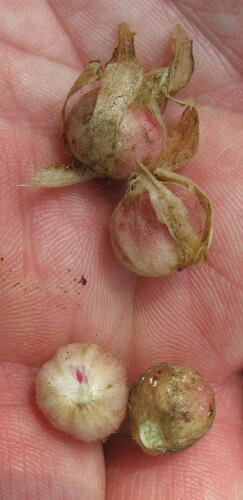
(c) Tomas Cedhagen, some rights reserved (CC BY-NC)
What to Eat
Edible parts: Seed, Fruit capsule, Spice, Flowers
The seeds are used as a spice in cakes and drinks. The fruit capsules, flowers, and seeds are all edible.
Where to Find It
It is a tropical plant. It grows in lowland areas and on hills up to 1,000 m above sea level. It grows on lower hills in Java. It is normally grown among trees. In Yunnan.
Asia, China, India, Indonesia*, Malaysia, SE Asia,
How to Identify
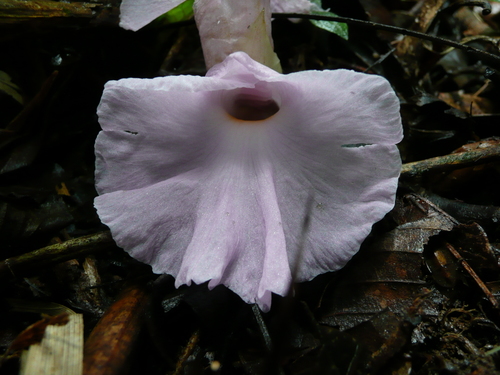
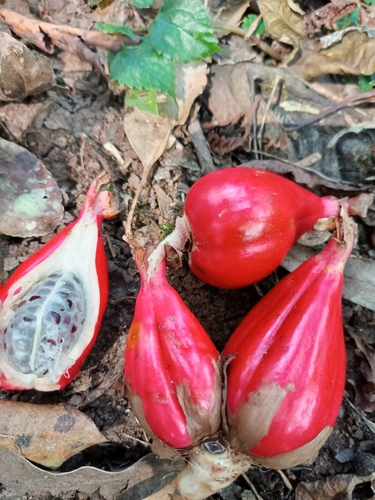
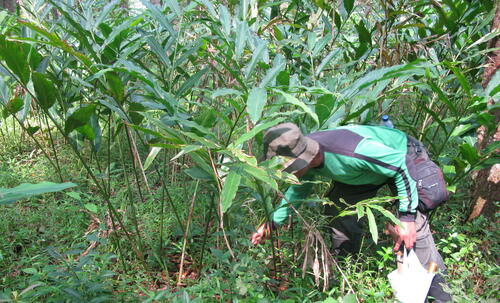
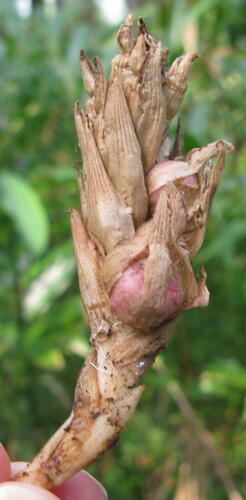
A ginger family herb. It grows 1-1.5 m tall. The leaves do not have leaf stalks. The leaves are sword shaped and 25-50 cm long by 4-9 cm wide. The flower spikes are cylinder shaped and 5 cm long by 2.5 cm wide. The bracts are yellow and the flowers are yellowish or white. The fruit is a capsule 1-2 cm across. The seeds are an irregular shape and 4 mm across.
How to Grow
It is planted from small pieces of the rhizome. It can be grown from seed.
Propagation: Seed - Rhizome cuttings or offsets of the plant clump. The rhizome cutting or offset (with rhizome part and adventitious roots) should bear 1 - 2 shoot buds or young plantlets 10 - 15cm tall, each with 4-8 leaves. Under dry weather conditions some of the lower leaves are removed to prevent rapid dehydration. Planting holes 50 cm deep and wide are first prepared, the soil is loosened and organic matter is incorporated. One or two cuttings are planted per hole, being placed about 10 cm deep.
Medicinal Uses
The seeds are stomachic and tonic. They are used as a remedy against colds and coughs, and as a tonic after childbirth. The seeds are chewed to sweeten the breath. A decoction of the whole plant is drunk as a tonic and to alleviate rheumatic pain. The plant is used to treat coughs and colds. The dried crushed rhizomes are taken to reduce fever and to combat intestinal pains.
Other Uses
Steam distillation of the seed yields an essential oil that is used in the perfume and flavour industry. The seeds yield 2 - 4% essential oil, composed primarily of 1,8-cineole (up to 70%), 'BETA'-pinene (16%), 'ALFA'-pinene (4%), 'ALFA'-terpineol (5%) and humulene (3%). Fresh rhizomes and roots have an essential-oil content of about 0.1% which also contains 1,8-cineole. The plant grows well in shade and can be planted under tree crops such as coconut or sugar palm.
Production
Plants flower and fruit after 3 years.
Other Information
It is cultivated.
Names & Synonyms
Buah pelaga, Cluster cardamomum, Java cardamom, Kalulaga jawa, Kepulaga, Pelaga, Pelaga Jawa, Puar
References (11)
- Bircher, A. G. & Bircher, W. H., 2000, Encyclopedia of Fruit Trees and Edible Flowering Plants in Egypt and the Subtropics. AUC Press. p 24 (As Amomum kepulaga)
- Burkill, I.H., 1966, A Dictionary of the Economic Products of the Malay Peninsula. Ministry of Agriculture and Cooperatives, Kuala Lumpur, Malaysia. Vol 1 (A-H) p 132 (As Amomum kepulaga)
- Gard. Bull. Straits Settlem. ser. 3, 6:10. 1929 (As Amomum kepulaga)
- Liu, Yi-tao, & Long, Chun-Lin, 2002, Studies on Edible Flowers Consumed by Ethnic Groups in Yunnan. Acta Botanica Yunnanica. 24(1):41-56
- Milow, P., et al, 2013, Malaysian species of plants with edible fruits or seeds and their evaluation. International Journal of Fruit Science. 14:1, 1-27
- Purseglove, J.W., 1972, Tropical Crops. Monocotyledons. Longmans p 528 (As Amomum kepulaga)
- Seidemann J., 2005, World Spice Plants. Economic Usage, Botany, Taxonomy. Springer. p 35
- Sukarya, D. G., (Ed.) 2013, 3,500 Plant Species of the Botanic Gardens of Indonesia. LIPI p 1060
- Sukenti, K., et al, 2016, Ethnobotanical study on local cuisine of the Sasak tribe in Lombok Island, Indonesia. Journal of Ethnic Foods. 3 (2016) 189-200 p 198
- Wiersema, J. H. & Leon, B., 2013, World Economic Plants. A Standard Reference CRC Press. 2nd Ed. p 47
- Zeven, A. C. & de West, J. M. J., 1982, Dictionary of cultivated plants and their regions of diversity. Wageningen. p 64 (As Amomum kepulaga)