Cnidium monnieri
(L.) Cusson ex Juss.
Snake's bed

(c) Chuangzao, some rights reserved (CC BY-NC), uploaded by Chuangzao
no rights reserved, uploaded by 葉子

(c) Chuangzao, some rights reserved (CC BY-NC), uploaded by Chuangzao
What to Eat
Edible parts: Fruit - flavouring, Shoots, Leaves flavouring
The leaves are used as a condiment. Young shoots are also eaten, though no further details are given; some caution is advised due to a report of slight toxicity.
Where to Find It
It is a temperate plant. It grows on the edge of fields and in grassland.
Asia, China, Europe, India, Indochina, Korea, Laos, Mongolia, North America, Russia, SE Asia, Siberia, Vietnam,
How to Identify
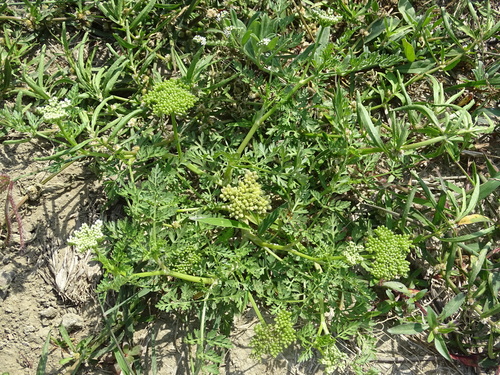
A herb. It grows each year from seed. It grows 10-60 cm tall. It has a thin taproot. There is one stem. The lower leaf stalks are 3-8 cm long. The leaves are oval and 3-8 cm long by 2-5 cm wide. There are leaflets along the stalk. These can be divided. The flowers are in groups 2-3 cm across. The fruit are oval and 2-3 mm long by 1-2 mm wide.
How to Grow
Propagation: Seed — no specific details are available for this species, but sowing as soon as the seed is ripe in a cold frame is recommended. Alternatively, sow stored seed in late winter in a cold frame. Once seedlings are large enough to handle, prick them out into individual pots and plant out in summer.
Medicinal Uses
She Chuang Zi has been used for thousands of years in Chinese herbal medicine, primarily as an external treatment in the form of lotion, powder, or ointment for skin conditions such as eczema, ringworm, and scabies. The seed is antipruritic, aphrodisiac, antirheumatic, astringent, carminative, discutient, sedative, vermifuge, and vulnerary. Internally, a decoction is used to treat Trichomonas vaginitis, leucorrhoea, and uterine displacement. The seed is also used for impotence, often combined with Schisandra chinensis. It has demonstrated an action similar to sex hormones, prolonging and reviving the copulation period and increasing the weight of the uterus, ovaries, prostate gland, and testes. A decoction of the seed or whole plant is applied externally to weeping eczema and other skin problems.
Other Uses
No other uses are known for this plant.
Wikipedia
Source ↗Cnidium monnieri (L.) Cusson ex Juss., Monnier's snowparsley, is a flowering plant species in the genus Cnidium. Also known as Shechuangzi, Osthole, Jashoshi, Cnidii Fructus (Fruits of Cnidium). It may be confused with Bacopa monnieri, Ligusticum officinale (syn. Cnidium officinale), both similar but different plants. The coumarins osthol, imperatorin and xanthotoxol can be found in C. monnieri.
Other Information
It is cultivated.
Names & Synonyms
Gieng sang, She ch'uang tzu, She Chuang Zi, Xa-sang
References (10)
- Ambasta, S.P. (Ed.), 2000, The Useful Plants of India. CSIR India. p 133, 565 (As Selinum monnieri)
- Amoen. acad. 4:269. 1755 (As Selinum monnieri)
- Arora, R. K., 2014, Diversity in Underutilized Plant Species - An Asia-Pacific Perspective. Bioversity International. p 105 (As Ligusticum monnieri)
- Brown, D., 2002, The Royal Horticultural Society encyclopedia of Herbs and their uses. DK Books. p 260 (As Ligusticum monnieri)
- Facciola, S., 1998, Cornucopia 2: a Source Book of Edible Plants. Kampong Publications, p 21 (As Ligusticum monnieri)
- Plants for a Future database, The Field, Penpol, Lostwithiel, Cornwall, PL22 0NG, UK. http://www.scs.leeds.ac.uk/pfaf/
- READ, (As Selinum monnieri)
- Seidemann J., 2005, World Spice Plants. Economic Usage, Botany, Taxonomy. Springer. p 112
- Uphof, (As Ligusticum monnieri)
- Zeven, A. C. & de West, J. M. J., 1982, Dictionary of cultivated plants and their regions of diversity. Wageningen. p 64 (As Ligusticum monnieri)