Geranium macrorrhizum
L.
Bulgarian geranium

(c) Luca Boscain, some rights reserved (CC BY-NC)

(c) Luca Boscain, some rights reserved (CC BY-NC)

(c) Luca Boscain, some rights reserved (CC BY-NC)
What to Eat
Edible parts: Leaves - flavouring, Flowers
None known.
Where to Find It
It is a temperate plant.
Alps, Balkans, Crimea, Russia, Slovenia,
How to Identify
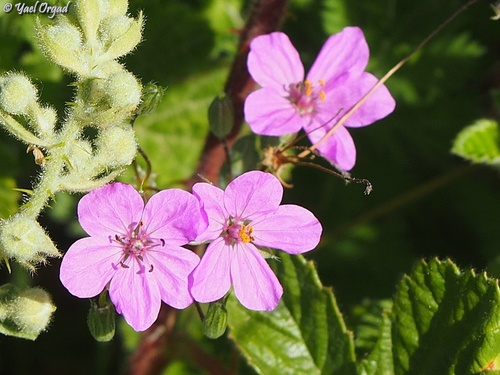
A fast-growing perennial reaching 0.5 m (1 ft 8 in) tall by 0.6 m (2 ft) wide. Blooms from June to August with hermaphroditic, insect-pollinated flowers. Extremely adaptable, tolerating full shade, semi-shade, or full sun in sandy, loamy, or clay soils with neutral to very alkaline pH. Drought-tolerant and prefers well-drained soil. Hardy to UK zone 4.
How to Grow
Easily grown in dry or moist situations, in sun or light shade. Succeeds even in deep shade. Tolerates a wide range of soil types, succeeding in any moderately fertile retentive soil. Calcicole. Established plants are drought resistant. A very ornamental plant, there are many named varieties. Members of this genus are rarely if ever troubled by browsing deer or rabbits.
Propagation: Sow seed in spring in a cold frame. Once seedlings are large enough to handle, prick them out into individual pots and plant out during summer. Division in spring or autumn is very easy — virtually every piece of a divided plant, whether it has roots or not, will grow and produce roots. Larger clumps can be replanted directly into permanent positions, though smaller clumps are better potted up and grown on in a cold frame until rooting well, then planted out in spring.
Medicinal Uses
Aphrodisiac.
Other Uses
The very aromatic leaves have been used as a source of geranium oil. They are used in pot-pourri and perfumery. The plant makes a good dense ground cover and is a very effective weed smotherer. Plants grow rampantly, rooting as they spread, and should be spaced about 60cm apart each way.
Wikipedia
Source ↗Geranium macrorrhizum is a species of hardy flowering herbaceous perennial plant in the genus Geranium, family Geraniaceae. It is native to the South east Alps and the Balkans. Its common names include bigroot geranium, Bulgarian geranium, and rock crane's-bill. It has five-lobed (palmate) leaves that are aromatic when crushed, with pale pink flowers in summer. It is cultivated as an ornamental plant in temperate regions, where it is used as a flowering groundcover, with named cultivars selected for flower colors from white through pink to magenta. The cultivars 'Ingwersen's Variety' (pale pink) and 'White-ness' have gained the Royal Horticultural Society's Award of Garden Merit. The plant has been used in traditional herbal medicine. One of the many components of the essential oil is the sesquiterpene ketone germacrone, which has been shown to have in vitro antimicrobial activity against the species Bacillus subtilis. An essential oil from it is also used in aromatherapy. In addition to oils, it contains flavonoids, sesquiterpenes, phenolic acids, pigments, vitamins, and mineral salts.
Names & Synonyms
Korenikasta krvomočnica
References (2)
- Petrova, I., et al, 2016, Five Edible Flowers – Valuable Source of Antioxidants in Human Nutrition. International Journal of Pharmacognosy and Phytochemical Research 2016; 8(4); 604-610
- Seidemann J., 2005, World Spice Plants. Economic Usage, Botany, Taxonomy. Springer. p 165