Crocus nudiflorus
Sm.
Autumn crocus
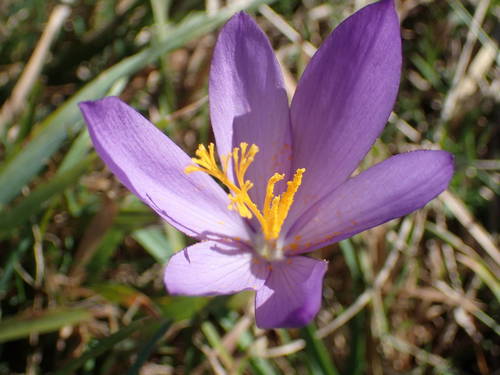
(с) Sylvain Piry, некоторые права защищены (CC BY-NC), загрузил Sylvain Piry

(c) arkim, some rights reserved (CC BY-NC)

(c) arkim, some rights reserved (CC BY-NC)
What to Eat
Edible parts: Bulbs, Roots, Flowers, Seeds
This species has been used as a saffron substitute. The following notes apply to genuine saffron (C. sativus): the flower styles serve as a flavouring and yellow colouring for foods including bread, soups, sauces, rice and puddings, and are also used as a tea substitute. The styles are extremely rich in riboflavin and are water soluble. Yields are very low — around 4,000 stigmas are needed to produce just 25g of saffron. It is the world's most expensive spice, requiring 150,000 flowers and 400 hours of labour to produce 1kg of dried saffron. Approximately 25kg of styles can be harvested per hectare.
Known Hazards
Where to Find It
It is a Mediterranean climate plant.
Europe, Spain,
How to Identify
A dwarf corm reaching 0.2 m tall. Flowers bloom September to October. Grows in light sandy to medium loamy soil, prefers well-drained conditions, and tolerates poor, very alkaline soil. Adapts to semi-shade or full sun with dry or moist soil. Hardy to UK zone 5 and not frost tender.
How to Grow
Prefers a well-drained sandy or loamy soil that is free from clay. Prefers some shade from the hottest sun in summer and at least a modicum of moisture during its summer dormancy. Succeeds in grass, so long as this is not mown until the leaves die down, it also grows well under deep-rooting deciduous trees and shrubs. It can also be grown with very low shallow-rooting groundcover plants such as lawn camomile (Chamaemelum nobile 'Treneague'). Plants are very frost hardy. Plants tend to move considerably from their original planting place because of their means of vegetative reproduction, it is therefore wise not to grow different species in close proximity. The corms should be planted about 5 - 8cm deep in the soil. Any planting out is best done in late spring or early summer. Plants take 4 - 5 years to come into flowering from seed. The flowers are only open during the day time, closing at night.
Propagation: Sow seed as soon as it is ripe in light sandy soil in pots in a cold frame, or alternatively in a cold frame in early spring. Seed usually germinates freely, so sow thinly; germination occurs within 1–6 months at 18°c. Avoid transplanting seedlings in their first year unless overcrowded, but apply regular liquid feeds to prevent nutrient deficiency. Once the plants die down, divide the small bulbs and plant 2–3 per 8cm pot. Grow on for a further two years in a greenhouse or frame, then plant out into permanent positions when dormant in late summer. Expect 3–4 years from seed to flowering. Clumps can also be divided after the leaves die down in spring, with bulbs replanted directly into permanent positions if desired.
Medicinal Uses
This species has been used as a saffron substitute. The following notes apply to genuine saffron (C. sativus): saffron has a long history of medicinal use. The flower styles and stigmas are the active parts, though their small size makes harvesting labour-intensive and the product is frequently adulterated. They are anodyne, antispasmodic, aphrodisiac, appetizer, carminative, diaphoretic, emmenagogue, expectorant, sedative and stimulant. Used as a diaphoretic for children and to treat chronic uterine haemorrhage in adults. The stigmas also yield a dental analgesic. Styles are harvested in autumn when the plant is flowering and dried for later use; they do not store well and should be used within 12 months. Use with caution — large doses can be narcotic, and quantities of 10g or more can cause abortion.
Other Uses
A yellow dye extracted from the stigmas has been used for centuries to colour cloth, and is traditionally associated with the robes of Indian swamis. A blue or green dye can be obtained from the petals.
Wikipedia
Source ↗Crocus nudiflorus is a species of flowering plant in the genus Crocus of the family Iridaceae. It is an autumn-flowering, dwarf, deciduous perennial found in western Europe from southwestern France to Spain. It has been cultivated since Tudor times in Great Britain, where it is now naturalized.
Names & Synonyms
Zargatena
References (4)
- Jacobsen, A. L., February 2013: edible Crocus www.arthurleej.com/plant of the month.html
- Pardo-de-Santayana et al, 2006, Diversity and selection of wild food plants. Proceedings of the IVth International Congress of Ethnobotany (ICEB) 2005) p 53
- Pardo-de-Santayana, M., et al, 2007, Traditional knowledge of wild edible plants used in the northwest of the Iberian Peninsula (Spain and Portugal): a comparative study. Journal of Ethnobiology and Ethnomedicine 2007, 3:27
- Tardio, J., et al, Ethnobotanical review of wild edible plants in Spain. Botanical J. Linnean Soc. 152 (2006), 27-71


