Ranunculus muricatus
L.
Pile wort

(c) Don Loarie, some rights reserved (CC BY)

(c) Tony Rodd, some rights reserved (CC BY-NC-SA)
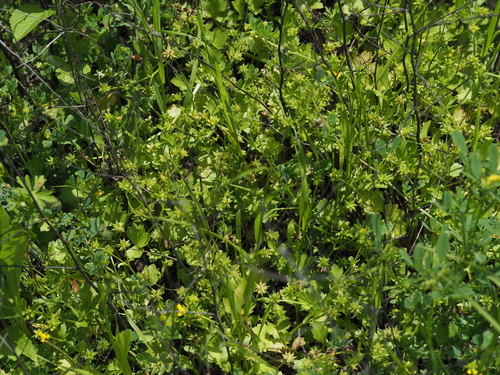
(c) Kimberlie Sasan, some rights reserved (CC BY-ND), uploaded by Kimberlie Sasan
What to Eat
Edible parts: Shoots, Leaves, Stems
None known.
Known Hazards
Where to Find It
It is a Mediterranean climate plant. In Argentina it grows from sea level to 1,000 m above sea level.
Africa, Argentina, Asia, Australia, Balkans, Bosnia, Central Asia, Croatia, India, Jordan, Korea, Libya, Mediterranean, Middle East, North Africa, NW India, Saudi Arabia, South America, Tajikistan, Tasmania,
How to Identify
An annual buttercup reaching 30cm tall. Hermaphroditic flowers are fly-pollinated. Tolerates light sandy, medium loamy, and heavy clay soils across mildly acidic to basic pH. Grows in semi-shaded woodland or full sun, preferring moist soil.
How to Grow
A weed of arable land. A greedy plant, inhibiting the growth of nearby plants, especially legumes.
Propagation: Sow seed in spring directly in situ.
Medicinal Uses
The plant is used in the treatment of intermittent fevers, gout, and asthma.
Other Uses
None known.
Wikipedia
Source ↗Ranunculus muricatus is a species of buttercup known by the common names rough-fruited buttercup and spinyfruit buttercup. It is native to Europe, but it can be found in many other places in the world, including parts of Africa, Australia, and the western and eastern United States, as an introduced species and agricultural and roadside weed. It grows in wet habitats, such as irrigation ditches. It is an annual or sometimes biennial herb producing a mostly hairless stem up to half a meter long which may grow erect or decumbent along the ground. The leaves have blades a few centimetres in length which are deeply divided into three lobes or split into three leaflets. They are hairless to hairy in texture, and are borne at the tips of long petioles. The flower has five shiny yellow petals under 1 centimetre (0.4 in) long around a lobed central receptacle studded with many stamens and pistils. The fruit is a spiny achene borne in a spherical cluster of 10 to 20.
Other Information
It is sold in local markets.
Names & Synonyms
Hwaireh, Thul hakh
References (4)
- Al-Qura'n, S. A., 2010, Ethnobotanical and Ecological Studies of Wild Edible Plants in Jordan. Libyan Agriculture Research Center Journal International 1(4):231-243
- Mahklouf, M. H., 2019, Ethnobotanical Study of Edible Wild Plants in Libya. European Journal of Ecology. 5(2): 30-40
- Luczaj et al, 2013, Wild vegetable mixes sold in the markets of Dalmatia (southern Croatia). Journal of Ethnobiology and Ethnomedicine. 8:2
- Luczaj, L. et al, 2014, Wild Food Plants of Dalmatia (Croatia). in A. Pieroni, C. L. Quave (eds.), Ethnobotany and Biocultural Diversities in the Balkans, p 142


