Cenchrus ciliaris
(Fig. & DeNot.) L.
Black Buffel Grass

(c) Luis Vigosa, some rights reserved (CC BY-NC), uploaded by Luis Vigosa
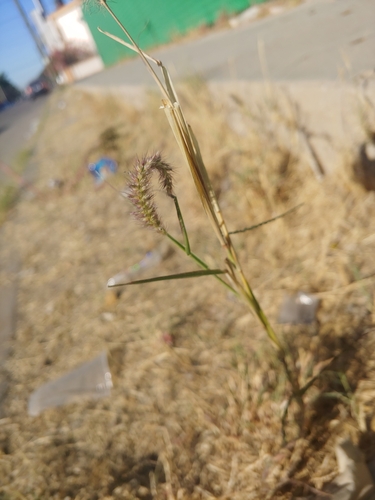
(c) Cristoffer Contreras, some rights reserved (CC BY-NC)
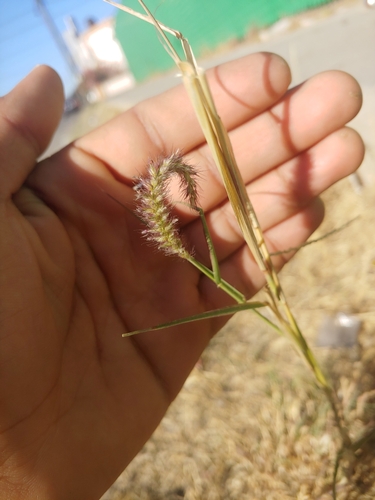
(c) Cristoffer Contreras, some rights reserved (CC BY-NC)
What to Eat
Edible parts: Seeds, Cereal
The seeds are eaten raw or mixed with millet (bajra) for bread making. It is used as a famine food.
Known Hazards
Where to Find It
It grows on alluvial flats. It suits Mediterranean regions. It also grows in tropical and temperate regions. In Bahrain it grows in compact gravelly soils in desert areas. It can grow in dry areas. It can grow in arid places. It is highly salt tolerant.
Africa, Arabia, Argentina, Asia, Australia, Bahrain, Botswana, Brazil, Burkina Faso, Cape Verde, Central Africa, China, Congo, East Africa, Eswatini, India, Iraq, Kenya, Madagascar, Mali, Mauritania, Middle East, Mozambique, Namibia, Niger, Nigeria, Pakistan, Paraguay, Sahel, Saudi Arabia, Senegal, Somalia, South Africa, Southern Africa, South America, Sudan, Swaziland, Taiwan, United Arab Emirates, UAE, West Africa, Zimbabwe,
How to Identify
A wiry tussocky grass. It keeps growing from year to year. It can have stolons or runners. It grows 0.2-1.5 m high. The leaves are 18 cm long. The flowers are purple. The seed head has a fluffy appearance due to long bristles.
Wikipedia
Source ↗Cenchrus ciliaris (buffel-grass or African foxtail grass; syn. Pennisetum ciliare (L.) Link) is a species of grass native to most of Africa, southern Asia (east to India), southern Iran, and the extreme south of Europe (Sicily). Other names by which this grass is known include dhaman grass, anjan grass and koluk katai.
Other Information
It is a famine food.
Notes
There are about 23 Cenchrus species.
Names & Synonyms
Ahitokotoko, Anjan, Baiba, Baldhoole-cagaar, Ciir dhunq, Dhaman, Foxtail grass, Kollukattai, Kusa, Sabat
References (19)
- Al-Sodany, Y. M., et al, 2013, Medicinal Plants in Saudi Arabia: I. Sarrwat Mountains at Taif, KSA. Academic Journal of Plant Sciences 6 (4): 134-145
- Ambasta S.P. (Ed.), 2000, The Useful Plants of India. CSIR India. p 115
- Burkill, H. M., 1985, The useful plants of west tropical Africa, Vol. 2. Kew.
- Famine foods
- Flora of Pakistan. www.eFloras.org
- Hall, N. et al, 1972, The Use of Trees and Shrubs in the Dry Country of Australia, AGPS, Canberra. p 50
- Hussey, B.M.J., Keighery, G.J., Cousens, R.D., Dodd, J., Lloyd, S.G., 1997, Western Weeds. A guide to the weeds of Western Australia. Plant Protection Society of Western Australia. p 46
- Karim, F. M. & Dakheel, A, J., 2006, Salt-tolerant plants of the United Arab Emirates. 2006. International Center for Biosaline Agriculture, Dubai, UAE. p 92
- Lazarides, M. & Hince, B., 1993, Handbook of Economic Plants of Australia, CSIRO. p 53
- Mant. pl. 2:302. 1771
- Paczkowska, G. & Chapman, A.R., 2000, The Western Australian Flora. A Descriptive Catalogue. Western Australian Herbarium. p 99
- Petheram, R.J. and Kok, B., 2003, Plants of the Kimberley Region of Western Australia. UWA Press p 77
- Phillips, D.C., 1988, Wild Flowers of Bahrain. A Field Guide to Herbs, Shrubs, and Trees. Privately published. p 108
- Purseglove, J.W., 1972, Tropical Crops. Monocotyledons. Longmans p 127
- SAXENA;
- SHANKARNARAYAN & SAXENA
- van Oudtshoorn, F and van Wyck, E., 2004, Guide to Grasses of Southern Africa. Briza. p 88
- Wheeler, J.R.(ed.), 1992, Flora of the Kimberley Region. CALM, Western Australian Herbarium, p 1135
- World Checklist of Useful Plant Species 2020. Royal Botanic Gardens, Kew


