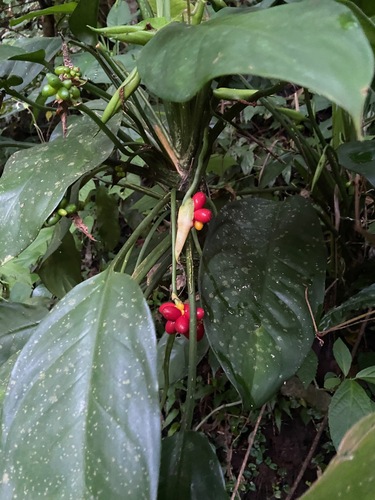
Amorphophallus kachinensis
Engl. et Gehrm.

(c) pgkaestner, some rights reserved (CC BY-NC), uploaded by pgkaestner

(c) Suzu Sato, some rights reserved (CC BY-NC)
What to Eat
Edible parts: Tuber, Corm, Vegetable, Roots, Leaves
Tuber - cooked. The corm must be thoroughly boiled or baked, it is acrid when raw (see notes above on 'Known Hazards'). The fresh corms are turned into curd, or are chopped then dried. The curd is relatively tasteless, but it absorbs flavours well and so can be used as a carbohydrate element in a wide range of other foods. The depressed, globose tuber can be 5 - 30cm in diameter and 3 - 5cm or more tall. Leaves - cooked?. They need to be thoroughly cooked. The report refers to the plant being grown as a vegetable and for its edible tuber - so the assumption is that, like several other members of this genus, the leaves are used as a vegetable.
Known Hazards
Where to Find It
It is a tropical plant. In southern China it grows on limestone rocks between 1,000-1,500 m above sea level. In Yunnan.
Asia, China, Indochina, Laos, Myanmar, SE Asia, Thailand,
How to Identify
A large herb. It is a root crop. It has one large leaf from the tuber. The stem is 20 cm or more long and the leaf is 100 cm wide. It has leaflets 6-9 cm long by 2-3 cm wide. The leaf stalk is a dirty white with dark green to brown spots. It is 20 cm long. The flower has an unpleasant smell.
How to Grow
Plants can be grown from seed or offsets.
Propagation: Seed - Offsets.
Other Information
It is occasionally cultivated.
Names & Synonyms
References (2)
- Fern, K., 2012, Tropical Species Database http://theferns.info/tropical/
- Xu, You-Kai, et al, 2004, Wild Vegetable Resources and Market Survey in Xishuangbanna, Southwest China. Economic Botany. 58(4): 647-667.