Dendrocalamus sinicus
L. C. Chia & J. L. Sun
Giant dragon bamboo
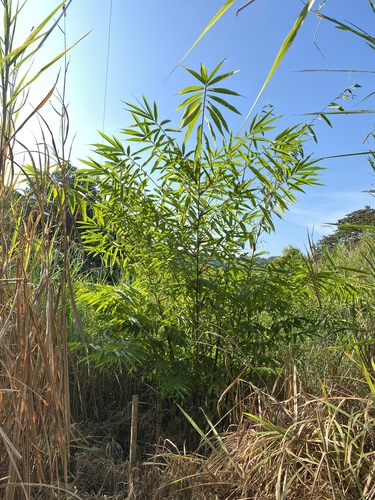
(c) GuaduaBamboo.com, some rights reserved (CC BY-NC), uploaded by GuaduaBamboo.com

Sajetpa at Malayalam Wikipedia (via Wikimedia Commons)
What to Eat
Edible parts: Shoots, Vegetable
The shoots are eaten cooked as a vegetable.
Where to Find It
It is a tropical plant. It grows between 600-1,000 m above sea level in Yunnan.
Asia, China, Indochina, Laos, SE Asia, Thailand,
How to Identify
A bamboo. It grows 20-30 m tall and the culms are 20-30 cm across. The internodes are 17-22 cm long. The leaf blade is 20-40 cm long by 4-7 cm wide.
Wikipedia
Source ↗Dendrocalamus sinicus, the dragon bamboo, is a gigantic clumping bamboo native to Yunnan Province of China and to Laos. It has the largest culms of any known species of bamboo; up to 36 cm (14 in) wide with culm walls up to 6 centimetres (2.4 in) thick and the culm up to 46 m (151 ft) height. Each culm can weigh up to 450 kg (990 lb) apiece. A plant eventually consists of about one hundred culms. This species was unknown to mainstream science prior to 1980, although well known to the people of Yunnan and Laos for centuries.
Other Information
It is a cultivated food plant. Shoots are sold in local markets.
Names & Synonyms
Bo', Ju long zhu, Maibao, Maibo, Phai chin, Phai hok wat chan, Puak
References (2)
- Luczaj, L., et al, 2021, Wild food plants and fungi sold in the markets of Luang Prabang, Lao PDR. Journal of Ethnobiology and Ethnomedicine (2021) 17:6
- Xu, You-Kai, et al, 2004, Wild Vegetable Resources and Market Survey in Xishuangbanna, Southwest China. Economic Botany. 58(4): 647-667.


