Indosasa singulispicula
T. H. Wen
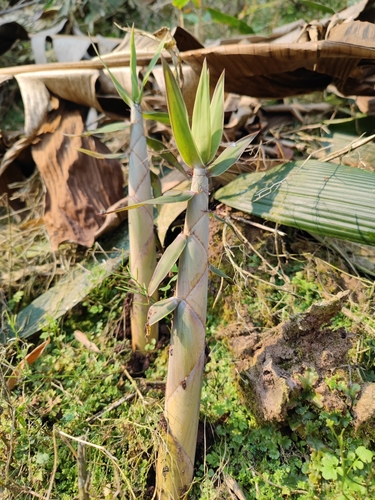
(c) 刘光裕 Liu Guangyu, some rights reserved (CC BY-NC), uploaded by 刘光裕 Liu Guangyu
What to Eat
Edible parts: Shoots, Vegetable
The shoots are cooked and eaten, though they are bitter.
Where to Find It
It is a tropical plant. It grows on low hills and near streams between 600-700 m above sea level in Yunnan.
Asia, China,
How to Identify
A bamboo. It grows 5-7 m tall. The stems are 1-2 cm across. The internodes are 10-30 cm long. There are 5-7 leaves on the last branch. The leaf blade is 13-26 cm long by 2-4 cm wide.
How to Grow
Indosasa species are native from the warm temperate to the tropical regions of southern China, Vietnam and Laos, usually at lower elevations. The climate is moist, with hot summers and short, mild to warm winters wth few, if any, frosts. They can generally be grown outdoors in hardiness zones 9 and higher, and with at least moderate levels of rainfall. Bamboos generally grow best in a sunny or moderately sunny position in a well-drained, fertile, open loam of reasonable quality with plenty of moisture in the growing season. Tropical bamboos have an interesting method of growth. New stems are usually produced in the rainly season, or at any ime of the year in some moist climates. Each stem will grow to its maximum height in the first few months, and any subsequent growth in the stem in future years is limited to the production of new side branches and leaves. Most bamboo species usually grow for many years without flowering. When they do finally flower it is not unusual for all the plants of that species in the region to also flower. Although some species just produce a few flowering stems each year (which die after flowwering, although the rest of the plant continues growing), in most species all of the stems will come into flower. They do so profusely over a period of 1 - 3 years and the whole plant will often then die, probably from exhaustion. Some species, if given plenty of organic matter at this time will gradually recover, although they will look rather poorly for a year or three. If fed with artificial NPK fertilizers at this time the plants are more likely to die. Bamboo species are usually notably resistant to honey fungus
Other Uses
The stems are used for shed frames and fences or for weaving.
Other Information
It is a cultivated food plant. It is sold in local markets.
Names & Synonyms
Aha, A ka bi, Lao dong, Lubulu, Maihong, Maikong
References (3)
- Cao, Y., et al, 2020, Ethnobotanical study on wild edible plants used by three trans-boundary ethnic groups in Jiangcheng County, Pu’er, Southwest China. Journal of Ethnobiology and Ethnomedicine (2020) 16:66
- Luo, B., et al, 2019, Wild edible plants collected by Hani from terraced rice paddy agroecosystem in Honghe Prefecture, Yunnan, China. Journal of Ethnobiology and Ethnomedicine 15:56
- Xu, You-Kai, et al, 2004, Wild Vegetable Resources and Market Survey in Xishuangbanna, Southwest China. Economic Botany. 58(4): 647-667.


