Hyptianthera stricta
(Roxb. ex Schult.) Wight & Arn.
RubiaceaeLeaves
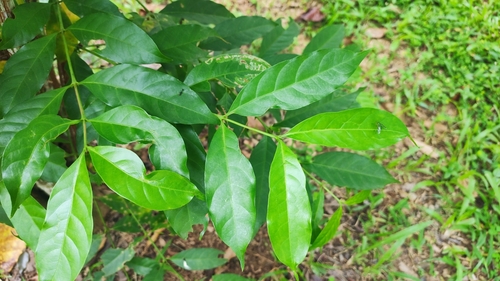
iNaturalist · cc-by-nc
(c) 刘光裕 Liu Guangyu, some rights reserved (CC BY-NC), uploaded by 刘光裕 Liu Guangyu
(c) 刘光裕 Liu Guangyu, some rights reserved (CC BY-NC), uploaded by 刘光裕 Liu Guangyu
What to Eat
Edible parts: Leaves
The leaves are cooked and eaten as a vegetable, and are sold in local markets.
Where to Find It
It is a tropical plant. It grows in forests, along streams and on mountains between 100-1,500 m above sea level. In Yunnan.
Asia, Bangladesh, Bhutan, China, Himalayas, India, Indochina, Laos, Myanmar, Nepal, SE Asia, Thailand, Tibet, Vietnam,
Countries: United Arab Emirates, Afghanistan, Armenia, Azerbaijan, Bangladesh, Bahrain, Brunei, Bhutan, China, Georgia, Indonesia, Israel, India, Iraq, Iran, Jordan, Japan, Kyrgyzstan, Cambodia, North Korea, South Korea, Kuwait, Kazakhstan, Laos, Lebanon, Sri Lanka, Myanmar, Mongolia, Maldives, Malaysia, Nepal, Oman, Philippines, Pakistan, Qatar, Saudi Arabia, Singapore, Syria, Thailand, Tajikistan, Timor-Leste, Turkmenistan, Turkey, Taiwan, Uzbekistan, Vietnam, Yemen
How to Identify
A shrub or small tree. It grows 2-8 m tall. The branches are flattened and angled. The leaves are oblong and 5-15 cm long by 1-5 cm wide. The flowers are small and white. The fruit are yellowish-green berries. They are 8-9 mm longb by 5-6 mm wide.
Other Information
Leaves are sold in local markets.
Notes
There is only one Hyptianthera species.
Names & Synonyms
Kyetyo, Pashuang
Hypobathrum strictum (Roxb. ex Schult.) KurzHyptianthera bracteata CraibMacrocnemum strictum Roxb. ex Schult.Randia stricta (Roxb. ex Schult.) Roxb.Rondeletia stricta (Roxb. ex Schult.) RothSolena stricta (Roxb. ex Schult.) D. Dietr.
References (3)
- Hui, Y. H., Handbook of Food Science, Technology, and Engineering. Volume 2. Table 98:5 (As Hyptianthera bracteata)
- Puff, C & Chayamarit, K., 2008, Additions to "Rubiaceae of Thailand. A pictorial guide to indigenous and cultivated genera" Thai For. Bull. 36:70-80, 2008
- Xu, You-Kai, et al, 2004, Wild Vegetable Resources and Market Survey in Xishuangbanna, Southwest China. Economic Botany. 58(4): 647-667.


