Premna tomentosa
Willd.
Woolly-leaved fire tree

(c) unknown|Author, some rights reserved (CC BY-SA)
(c) Vikas D Prasad, some rights reserved (CC BY-SA), uploaded by Vikas D Prasad
(c) Vikas D Prasad, some rights reserved (CC BY-SA), uploaded by Vikas D Prasad
What to Eat
Edible parts: Leaves, Vegetable
Young leaves are cooked and eaten as a vegetable.
Where to Find It
It is a tropical plant. It grows in dry evergreen and dry deciduous forests. It grows up to 1,400 m above sea level.
Africa, Asia, Australia, China, Egypt, Himalayas, India, Indochina, Indonesia, Malaysia, Myanmar, Nepal, SE Asia, Sri Lanka, Thailand, Vietnam,
How to Identify
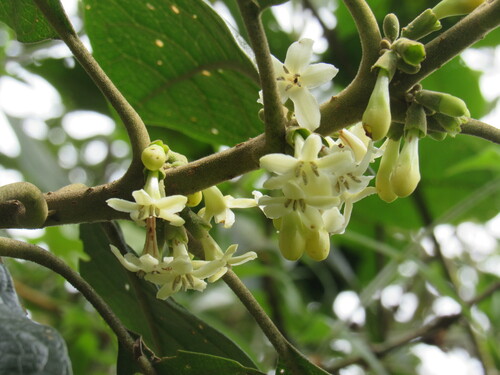
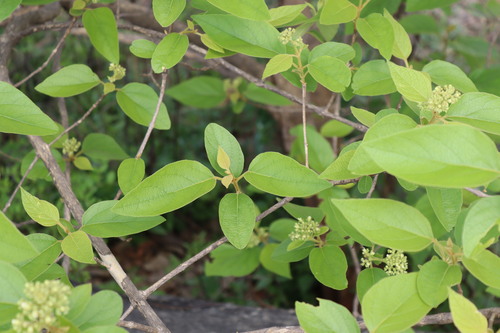
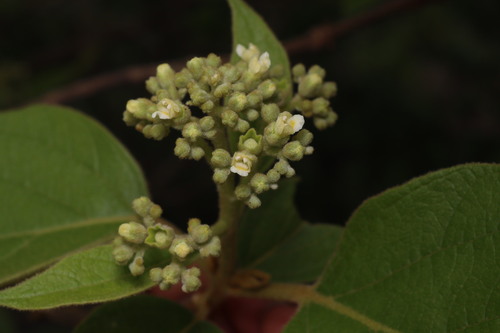
A tree. It loses its leaves during the year. It grows 4-6 m tall. The bark is grey and smooth. The leaves are simple and opposite. The leaf stalk is 2-5 cm long. The leaf blade is 6-25 cm long by 5-15 cm wide. They have a white coating underneath. The flowers are small and yellow. The fruit is small and black and 5-6 mm long. There are 4 seeds.
How to Grow
It can be grown from root suckers. It can be grown by seed. It can be grown from cuttings.
Medicinal Uses
A decoction of the roots and leaves has been used as a tonic in mixtures after childbirth. The leaves are reputed to have diuretic properties, and they are used externally to treat dropsy. They are crushed and applied as a poultice to sores. The dried entire plant is used as a poultice to soothe skin irritation caused by caterpillars. The bark has been used to treat diarrhoea.
Other Uses
The light brown wood is smooth, close-grained and hard, It is used for house building, furniture, weaving shuttles, and also for carving, turnery and fancy work. Both in colour and texture this timber closely resembles satinwood (Chloroxylon Swietenia), so much so that it would readily pass for it.
Notes
Also put in the family Verbenaceae.
Names & Synonyms
Kyun-bo, Mai-sak-hpu, Mai-sak-kai, Nelli, Pohon premna wolan
References (2)
- Reddy, K. N. et al, 2007, Traditional knowledge on wild food plants in Andhra Pradesh. Indian Journal of Traditional Knowledge. Vol. 6(1): 223-229
- Sukarya, D. G., (Ed.) 2013, 3,500 Plant Species of the Botanic Gardens of Indonesia. LIPI p 470