Garcinia nitida
Pierre
Brunei cherry
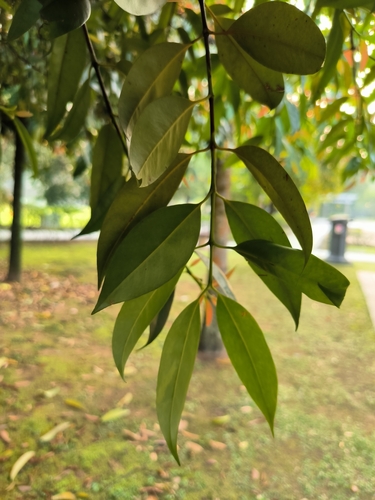
(c) Rafidah Abdul Rahman, some rights reserved (CC BY-NC), uploaded by Rafidah Abdul Rahman

President and Fellows of Harvard College
What to Eat
Edible parts: Fruit
The acidic fruit pulp is used in cooking to provide sour flavor. The dried rind is also used to impart an acidic taste to cooked fish.
Where to Find It
It is a tropical plant. It is an understorey plant in tropical rainforest. It grows at low altitudes.
Asia, Brunei, Indonesia, Malaysia, SE Asia,
How to Identify
A small evergreen tree. The branches are drooping. The leaves are large and oval. The base is wedge shaped. The fruit is a flattened round shape and 3-4 cm across. It is pale green but turns pink to red when ripe.
How to Grow
Plants can be grown by root cuttings.
Wikipedia
Source ↗Garcinia nitida, also known as kandis hutan, is a species of flowering plant, a dioecious understorey fruit tree in the mangosteen family, that is native to Southeast Asia.
Names & Synonyms
Asam alui-alui, Asam aur-aur, Kandis
References (5)
- Lim, T. K. Edible Medicinal and Non-Medicinal Plants Volume 2, Fruits. Springer p 112
- Milow, P., et al, 2013, Malaysian species of plants with edible fruits or seeds and their evaluation. International Journal of Fruit Science. 14:1, 1-27
- Septiani, Y. & Sidabutar, H., (Eds.) 2015, Biodiversity Survey. In the Sub Watershed Embaloh, Betung Kerihun National Park. ITTO p 82
- Siong, K. H., 2003, Indigenous Fruits of Sarawak. ITTO & Sarawak Forest Department. p 47
- Uji, T., 2007, Keanekaragaman, Persebaran dan Potensi Jenis-jenis Garcinia. Berk. Penel. Hayati: 12 (129–135), 2007


