Neolentinus lepideus
(Fr.) Redhead & Ginns
GloeophyllaceaeMushrooms
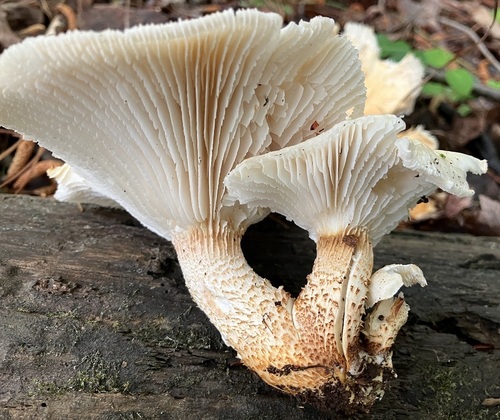
iNaturalist · cc-by-nc
(c) Cindi Fitzgerald, some rights reserved (CC BY-NC), uploaded by Cindi Fitzgerald
(c) Cindi Fitzgerald, some rights reserved (CC BY-NC), uploaded by Cindi Fitzgerald

iNaturalist · cc-by-nc
(c) Adam Arendell, some rights reserved (CC BY-NC), uploaded by Adam Arendell
(c) Adam Arendell, some rights reserved (CC BY-NC), uploaded by Adam Arendell

iNaturalist · cc-by-nc-sa
(c) Tatiana Bulyonkova, some rights reserved (CC BY-NC-SA)
(c) Tatiana Bulyonkova, some rights reserved (CC BY-NC-SA)
What to Eat
Edible parts: Mushroom, Fungus
The mushroom is edible.
Where to Find It
It is a subtropical plant.
Asia, China, Hong Kong, Mexico, North America,
Countries: United Arab Emirates, Afghanistan, Antigua & Barbuda, Armenia, Azerbaijan, Barbados, Bangladesh, Bahrain, Brunei, Bahamas, Bhutan, Belize, Canada, China, Costa Rica, Cuba, Dominica, Dominican Republic, Grenada, Georgia, Guatemala, Honduras, Haiti, Indonesia, Israel, India, Iraq, Iran, Jamaica, Jordan, Japan, Kyrgyzstan, Cambodia, St Kitts & Nevis, North Korea, South Korea, Kuwait, Kazakhstan, Laos, Lebanon, St Lucia, Sri Lanka, Myanmar, Mongolia, Maldives, Mexico, Malaysia, Nicaragua, Nepal, Oman, Panama, Philippines, Pakistan, Puerto Rico, Qatar, Saudi Arabia, Singapore, El Salvador, Syria, Thailand, Tajikistan, Timor-Leste, Turkmenistan, Turkey, Trinidad & Tobago, Taiwan, United States, Uzbekistan, St Vincent, Vietnam, Yemen
How to Identify
A subtropical mushroom in the family Gloeophyllaceae.
Wikipedia
Source ↗Neolentinus lepideus is a basidiomycete mushroom of the genus Neolentinus, until recently also widely known as Lentinus lepideus. Common names for it include scaly sawgill, scaly lentinus and train wrecker.
Names & Synonyms
Several
References (4)
- Boa, E. R., 2004, Wild edible fungi and their importance to people. FAO Non Wood Forest Products Booklet 17
- Garibay-Orijel, R., et al, 2007, Understanding cultural significance, the edible mushrooms case. Journal of Ethnobiology and Ethnomedicine. 3:4
- Li, H., et al, 2020, Reviewing the world’s edible mushroom species: A new evidence-based classification system. Compr Rev Food Sci Food Saf. 2021;20:1982–2014.
- Santiago, F, H., et al, 2016, Traditional knowledge and use of wild mushrooms by Mixtecs or Ñuu savi, the people of the rain, from Southeastern Mexico. Journal of Ethnobiology and Ethnomedicine 12:35 p 8
