Cephalotaxus lanceolata
Feng
Yunnan plum yew

(c) Caleb Catto, some rights reserved (CC BY)
(c) Caleb Catto, some rights reserved (CC BY)
(c) Caleb Catto, some rights reserved (CC BY)
What to Eat
Edible parts: Fruit, Seeds
No detailed information is available for this species, but as a close relative of C. fortunei it is quite likely to have edible fruit and seed. The fruit is up to 4.5cm long and 2cm wide and is considered worthy of further research. As with related species, the fruit does not always ripen in Britain; before full ripeness it has a strongly unpleasant resinous flavour that coats the mouth and can persist for hours.
Where to Find It
It is a tropical plant. It grows in broad-leaved forest at about 1,900 m in Yunnan in China.
Asia, China, Myanmar, SE Asia,
How to Identify
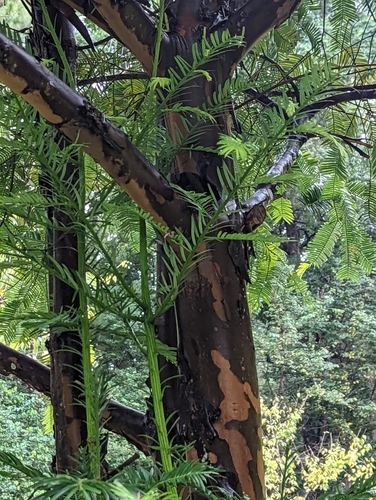
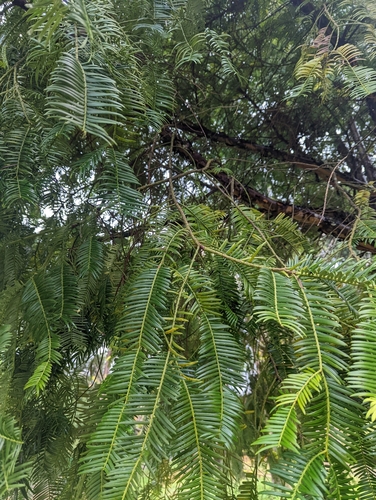
A tree. It grows 20 m tall. The trunk is 40 cm across. The bark is purple and smooth. The branches hang down. The leafy branches are V shaped in cross section. The leaves spread at about 45° to the branch. They are 5-10 cm long by 4-7 mm wide and taper to the tip. The seeds are oval and 3.5-4.5 cm long.
How to Grow
Prefers a moist well-drained sandy soil but succeeds in most soils though it dislikes dry gravelly or chalky soils. Prefers a position in semi-shade but tolerates full shade and it also succeeds but does not usually thrive in full sun. It grows very well in the mild wet coastal region of W. Scotland where it succeeds even in full sun. Requires a humid sheltered site, strongly disliking very exposed positions. This species is not hardy in the colder areas of the country, it tolerates temperatures down to between -5 and -10°c. The young growth in spring, even on mature plants, is frost-tender and so it is best to grow the plants in a position sheltered from the early morning sun. This plant has become very rare in its native range and is designated an endangered species. Plants are dioecious, but female plants sometimes produce fruits and infertile seeds in the absence of any male plants. However, at least one male plant for every five females should be grown if you are growing the plants for fruit and seed. Plants have also been known to change sex. Male cones are produced in the axils of the previous year's leaves, whilst female cones are borne at the base of branchlets.
Propagation: Seed is best sown as soon as it is ripe in a cold frame, where it should germinate the following spring. A hard seedcoat can delay germination, particularly if seed is not sown fresh. Stored seed should be cold-stratified before sowing in a cold frame in spring; germination can take 18 months or more. Prick out seedlings as soon as they are large enough to handle and grow on under cover for at least their first winter. Plant out in late spring after the last expected frosts. Greenwood cuttings of terminal shoots can be taken in August or September in a humid cold frame, though this method is difficult.
Medicinal Uses
No medicinal uses are known for this plant.
Other Uses
Very tolerant of pruning, this plant makes an excellent hedge in shady positions.
Wikipedia
Source ↗Cephalotaxus lanceolata is a coniferous tree in the family Taxaceae. It is native to northern Burma and southern China. It is often considered a variety of C. fortunei.
Production
In China seeds are mature in September to November.
Notes
There are about 10 Cephalotaxus species. Also put in the family Cephalotaxaceae. It is an endangered species in China.
Names & Synonyms
Yunnan Plum, Yunnan Plum Yew, Plum Yew
References (2)
- Plants for a Future database, The Field, Penpol, Lostwithiel, Cornwall, PL22 0NG, UK. http://www.scs.leeds.ac.uk/pfaf/
- www.eFloras.org Flora of China


