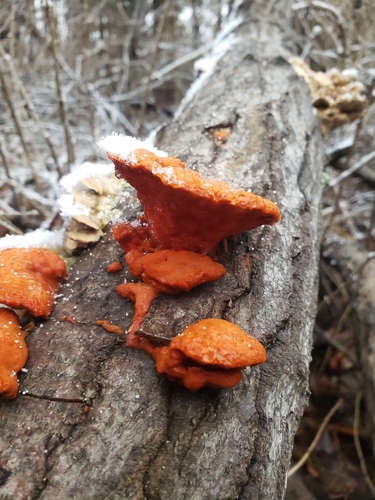
Pycnoporus cinnabarinus
(Jacq.) P. Karst.
CoriolaceaeMushrooms

iNaturalist · cc-by-nc
(c) Rebecca Twiss, some rights reserved (CC BY-NC)
(c) Rebecca Twiss, some rights reserved (CC BY-NC)

iNaturalist · cc-by-nc
(c) Rebecca Twiss, some rights reserved (CC BY-NC)
(c) Rebecca Twiss, some rights reserved (CC BY-NC)
iNaturalist · cc-by-nc
(c) Paul Pernici, some rights reserved (CC BY-NC)
(c) Paul Pernici, some rights reserved (CC BY-NC)
What to Eat
Edible parts: Mushroom, Fungus
The mushroom fungus is edible.
Where to Find It
It is a temperate plant.
Asia, Himalayas, Nepal,
Countries: United Arab Emirates, Afghanistan, Armenia, Azerbaijan, Bangladesh, Bahrain, Brunei, Bhutan, China, Georgia, Indonesia, Israel, India, Iraq, Iran, Jordan, Japan, Kyrgyzstan, Cambodia, North Korea, South Korea, Kuwait, Kazakhstan, Laos, Lebanon, Sri Lanka, Myanmar, Mongolia, Maldives, Malaysia, Nepal, Oman, Philippines, Pakistan, Qatar, Saudi Arabia, Singapore, Syria, Thailand, Tajikistan, Timor-Leste, Turkmenistan, Turkey, Taiwan, Uzbekistan, Vietnam, Yemen
How to Identify
Pycnoporus cinnabarinus is a mushroom fungus in the family Coriolaceae, found in temperate regions.
Wikipedia
Source ↗Pycnoporus cinnabarinus, also known as the cinnabar polypore, is a saprophytic, white rot decomposer. Its fruit body is a bright orangish shelf fungus up to 12 centimetres (4+3⁄4 in) across and 1.5 cm (5⁄8 in) thick. It stains dark in potassium hydroxide. There 2–4 pores per mm. The spore print is white. It is common in many areas and is widely distributed throughout the world. It is inedible. It produces cinnabarinic acid to protect itself from bacteria.
References (1)
- Boa, E. R., 2004, Wild edible fungi and their importance to people. FAO Non Wood Forest Products Booklet 17