Chaerophyllum bulbosum
L.
Bulbous chervil, Parsnip chervil, Tuberous chervil, Turnip-root chervil
(c) Yurii Basov, some rights reserved (CC BY)

(c) berlinflower, some rights reserved (CC BY-NC)

(c) Yurii Basov, some rights reserved (CC BY)
What to Eat
Edible parts: Leaves, Root, Tuber, Vegetable
The root can be eaten raw or cooked. Raw, it is somewhat tough but has a pleasant aromatic, starchy flavour; when cooked it becomes floury and sweet with a distinctive, excellent flavour unlike any other vegetable. Peeling the roots before eating ruins the flavour. The roots are roughly the size of a small carrot and contain around 20% starch and 4% protein. They can be harvested when the foliage dies back — typically July or August from an autumn sowing — and stored like potatoes for later use, though harvesting as needed gives the best results. Young stems can also be eaten raw or cooked, though some caution is advised (see known hazards).
Known Hazards
Where to Find It
It is a temperate plant.
Armenia, Australia, Austria, Balkans, Belarus, Britain, Bulgaria, Caucasus, Czech Republic, Europe, Finland, France, Georgia, Germany, Hungary, Iran, Italy, Luxembourg, Mediterranean, Middle East, Moldova, North America, Poland, Romania, Russia, Scandinavia, Siberia, Slovakia, Sweden, Switzerland, Turkey, Türkiye, Ukraine, USA, Yugoslavia,
How to Identify
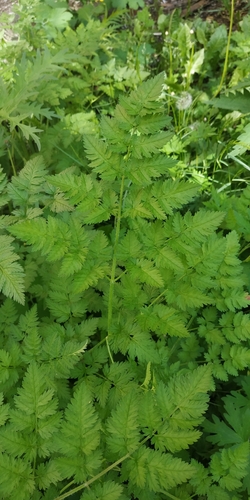
A herb which takes 2 years to complete its life cycle. It has round tuber like root. The leaves are in a ring. The flowering plant can be 70 cm to 2 m tall. The stem is smooth. It is hairy near the base. The leaves on the stem are alternate, arranged in spirals and with leaflets along the stalk. The bases of the leaves sheath the stem.
How to Grow
An easily grown plant, succeeding in almost any soil, though it prefers a moist soil. Tolerates a pH in the range 4.6 to 7. The turnip-rooted chervil is occasionally cultivated for its edible root, there is at least one named variety. The sub-species C. bulbosum prescottii (synonym C. prescottii) is used in Russia. The root of this sub-species contains about 17% starch.
Propagation: Seed is best sown in autumn directly in situ. Viability is very short, and according to some reports the seed becomes dormant if allowed to dry out, failing to germinate for up to a year. Seed saved for spring sowing should be kept in damp sand in a cold but frost-free place, then sown in situ in March. Alternatively, sow in autumn into a seed tray in a cold frame, then transfer the seed along with its soil and sow the whole lot in situ in early April.
Medicinal Uses
None known.
Other Uses
None known.
Wikipedia
Source ↗Chaerophyllum bulbosum is a species of flowering plant from the carrot family and known by several common names, including turnip-rooted chervil, tuberous-rooted chervil, bulbous chervil, and parsnip chervil. It is native to Europe and Western Asia. It was a popular vegetable in the 19th century. This is a tall annual herb with fringelike divided leaves and large umbels of white flowers. The plant is cultivated on a small scale in parts of Europe for the edible tubers, which look like a dark gray carrot with yellowish-white flesh. After the harvest they are stored for a few months under cold conditions. During storage, sugar content increases through hydrolysis of starch by amylases.
Other Information
It is a commercially cultivated vegetable. The raw tubers are especially eaten by children. It is sold in local markets.
Names & Synonyms
Baldaran, Baraboj, Bubalyka, Bubolyicska, Gemuk, Ghemias, Handok, Hilak, Homik, Kervel, Kimi, Krabilice hliznat, Krkoska, Mandak, Mendik, Mihalka, Repa, Repka, Shushan, Shushanbanjar
References (33)
- Arora, R. K., 2014, Diversity in Underutilized Plant Species - An Asia-Pacific Perspective. Bioversity International. p 24
- Brouk, B., 1975, Plants Consumed by Man. Academic Press, London. p 102
- Bussman, R. W., et al, 2016, A comparative ethnobotany of Khevsureti, Samtskhe-Javakheti, Tusheti, Svaneti, and Racha-Lechkhumi, Republic of Georgia (Sakartvelo), Caucasus. Journal of Ethnobiology and Ethnomedicine (2016) 12:43 (Also as Chaerophyllum caucasicum)
- Bussman, R. W. et al, 2017, Ethnobotany of Samtskhe-Javakheti, Sakartvelo (Republic of Georgia), Caucasus. Indian Journal of Traditional Knowledge Vol. 16(1) pp 7-24 (As Chaerophyllum caucasicum)
- Bussman, R. W., et al, 2021, Unity in diversity—food plants and fungi of Sakartvelo (Republic of Georgia), Caucasus. Journal of Ethnobiology and Ethnomedicine (2021) 17:72 p 5 (Also as Chaerophyllum caucasicum)
- Denes, A., et al, 2012, Wild plants used for food by Hungarian ethnic groups living in the Carpathian Basin. Acta Societatis Botanicorum Poloniae 81 (4): 381-396
- Dogan, A., et al, 2014, A review of edible plants on the Turkish Apiaceae species. J. Fac. Pharm. Istanbul, 44(2) pp 251-262
- Dogan, A. & Tuzlaci, E., 2015, Wild Edible Plants of Pertek (Tunceli-Turkey). Marmara Pharmaceutical Journal 19: 126-135
- Ertug, F, Yenen Bitkiler. Resimli Türkiye Florası -I- Flora of Turkey - Ethnobotany supplement
- Facciola, S., 1998, Cornucopia 2: a Source Book of Edible Plants. Kampong Publications, p 17
- Hammer, K. & Spahillari, M., 1999, Crops of European origin. in Report of a networking group on minor crops. IPGRI p 44
- Hedrick, U.P., 1919, (Ed.), Sturtevant's edible plants of the world. p 182
- Hovsepyan, R., et al, 2016, Food as a marker for economy and part of identity: traditional vegetal food of Yezidis and Kurds in Armenia. Journal of Ethnic Foods. 3:32-41
- Kays, S. J., and Dias, J. C. S., 1995, Common Names of Commercially Cultivated Vegetables of the World in 15 languages. Economic Botany, Vol. 49, No. 2, pp. 115-152
- Kiple, K.F. & Ornelas, K.C., (eds), 2000, The Cambridge World History of Food. CUP p 1751
- Lim, T. K., 2015, Edible Medicinal and Non Medicinal Plants. Volume 9, Modified Stems, Roots, Bulbs. Springer p 23
- Luczaj, L., 2012, Ethnobotanical review of wild edible plants of Slovakia. Acta Societatis Botanicorum Poloniae 81(4):245-255
- Martin, F.W. & Ruberte, R.M., 1979, Edible Leaves of the Tropics. Antillian College Press, Mayaguez, Puerto Rico. p 222
- Nanagulyan, S., et al, 2020, Wild plants and fungi sold in the markets of Yerevan (Armenia). Journal of Ethnobiology and Ethnomedicine 16:26
- Nedelcheva A., 2013, An ethnobotanical study of wild edible plants in Bulgaria. EurAsian Journal of BioSciences 7, 77-94
- Pieroni, A., et al, 2020, Wild food plants traditionally gathered in central Armenia: archaic ingredients or future sustainable foods? Environment, Development and Sustainability. Springer p 7
- Plants for a Future database, The Field, Penpol, Lostwithiel, Cornwall, PL22 0NG, UK. http://www.scs.leeds.ac.uk/pfaf/
- Seidemann J., 2005, World Spice Plants. Economic Usage, Botany, Taxonomy. Springer. p 94
- Self, M., 199, Phoenix Seeds catalogue. p 9
- Simkova, K. et al, 2014, Ethnobotanical review of wild edible plants used in the Czech Republic. Journal of Applied Botany and Food Quality 88, 49-67
- Sp. pl. 1:258. 1753
- Tronickova, E. & Krejcova, Z., 1987, Ortaggi, Instituto Geografico de Agostini, Cecoslovacchia. p 50
- Turner, N. J. et al, 2011, Edible and Tended Wild Plants, Traditional Ecological Knowledge and Agroecology. Critical Reviews in Plant Sciences, 30:198-225
- Ulian, T., et al, 2020, Unlocking plant resources to support food security and promote sustainable agriculture. Plants, People, Planet. 2020;2:421–445.
- USDA, ARS, National Genetic Resources Program. Germplasm Resources Information Network - (GRIN). [Online Database] National Germplasm Resources Laboratory, Beltsville, Maryland. Available: www.ars-grin.gov/cgi-bin/npgs/html/econ.pl (10 April 2000)
- van Wyk, B., 2005, Food Plants of the World. An illustrated guide. Timber press. p 63
- Wiersema, J. H. & Leon, B., 2013, World Economic Plants. A Standard Reference CRC Press. 2nd Ed. p 164
- World Checklist of Useful Plant Species 2020. Royal Botanic Gardens, Kew