Carex stramentitia
Boott ex Boecker
CyperaceaeSeeds/Nuts

gbif · cc0
Royal Botanic Garden Edinburgh
Royal Botanic Garden Edinburgh

gbif · cc0
Royal Botanic Garden Edinburgh
Royal Botanic Garden Edinburgh

gbif · cc0
Conveyor Belt
Conveyor Belt
What to Eat
Edible parts: Seeds
The seeds are eaten raw.
Where to Find It
It is a tropical plant. It grows in grasslands near woods between 100-1,000 m above sea level in southern China. In Yunnan.
Asia, Bhutan, China, Himalayas, India, Indochina, Indonesia, Myanmar, Nepal, SE Asia, Thailand, Vietnam,
Countries: United Arab Emirates, Afghanistan, Armenia, Azerbaijan, Bangladesh, Bahrain, Brunei, Bhutan, China, Georgia, Indonesia, Israel, India, Iraq, Iran, Jordan, Japan, Kyrgyzstan, Cambodia, North Korea, South Korea, Kuwait, Kazakhstan, Laos, Lebanon, Sri Lanka, Myanmar, Mongolia, Maldives, Malaysia, Nepal, Oman, Philippines, Pakistan, Qatar, Saudi Arabia, Singapore, Syria, Thailand, Tajikistan, Timor-Leste, Turkmenistan, Turkey, Taiwan, Uzbekistan, Vietnam, Yemen
How to Identify
A sedge. It has a long rhizome. The stems are tufted and 30-75 cm tall. They are 3 sided. The leaves are flat and 1-2 mm wide. It has a compound flower panicle 20-30 cm across and 3-5 branched. There are many spikes. The seeds are oval and 3 sided. They are 3 mm across.
References (1)
- Srivastava, R. C., 2010, Traditional knowledge of Nyishi (Daffla) tribe of Arunachal Pradesh. Indian Journal of Traditional Knowledge. 9(1):26-37 (As Carex filicina Boeckeler ex C. B. Clarke [Invalid])
More from Cyperaceae

Actinoscirpus grossus
Giant bulrush, Greater club-rush

Actinoscirpus grossus var. kysoor
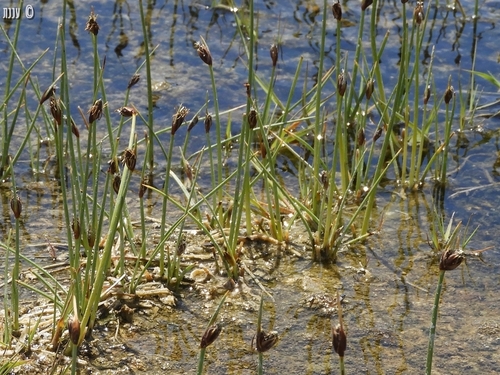
Amphiscirpus nevadensis
Nevada bulrush, Great basin bulrush

Bolboschoenus caldwellii
Sea club rush, Marsh club rush, Seaside bulrush

Bolboschoenus fluviatilis
Marsh club rush, River bulrush, Kukuraho, Purua grass

Bolboschoenus glaucus