Actaea dahurica
(Turcz. ex Fisch. & C. A. Mey.) Franch.
RanunculaceaeLeaves

iNaturalist · cc-by
(c) Repina Tatyana, some rights reserved (CC BY), uploaded by Repina Tatyana
(c) Repina Tatyana, some rights reserved (CC BY), uploaded by Repina Tatyana
iNaturalist · cc-by
(c) Repina Tatyana, some rights reserved (CC BY), uploaded by Repina Tatyana
(c) Repina Tatyana, some rights reserved (CC BY), uploaded by Repina Tatyana
What to Eat
Edible parts: Leaves
Where to Find It
It is a temperate plant. It grows in Inner Mongolia in China.
Asia, China, Korea, Mongolia,
Countries: United Arab Emirates, Afghanistan, Armenia, Azerbaijan, Bangladesh, Bahrain, Brunei, Bhutan, China, Georgia, Indonesia, Israel, India, Iraq, Iran, Jordan, Japan, Kyrgyzstan, Cambodia, North Korea, South Korea, Kuwait, Kazakhstan, Laos, Lebanon, Sri Lanka, Myanmar, Mongolia, Maldives, Malaysia, Nepal, Oman, Philippines, Pakistan, Qatar, Saudi Arabia, Singapore, Syria, Thailand, Tajikistan, Timor-Leste, Turkmenistan, Turkey, Taiwan, Uzbekistan, Vietnam, Yemen
How to Identify
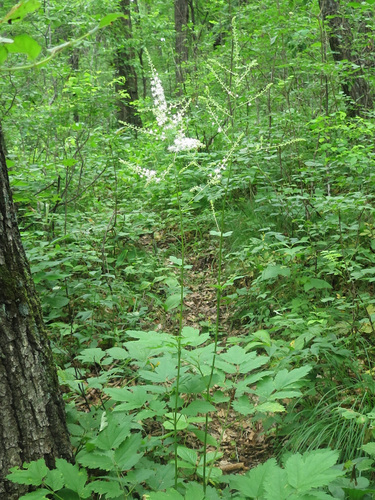
A herb. It keeps growing from year to year. It has a robust creeping rhizome or underground stem. This has many fibrous roots. The stems are simple and erect. The leaves are the base are scaly. The leaves on the stem are alternate. The flowers are small.
Names & Synonyms
Actinospora dahurica Turcz. ex Fisch. & C. A. Mey.Cimicifuga dahurica (Turcz. ex Fisch. & C. A. Mey) Maxim.
References (2)
- Urgamal, M., Oyuntsetseg, B., Nyambayar, D. & Dulamsuren, Ch. 2014. Conspectus of the vascular plants of Mongolia. (Editors: Sanchir, Ch. & Jamsran, Ts.). Ulaanbaatar, Mongolia. “Admon“ Press. 334pp. (p. 79-90).
- Wujisguleng, W., & Khasbagen. K., 2010, An integrated assessment of wild vegetable resources in Inner Mongolian Autonomous Region, China. Journal of Ethnobiology and Ethnomedicine 6:34


