Cecropia sciadophylla
Mart.
Igarata pumpwood
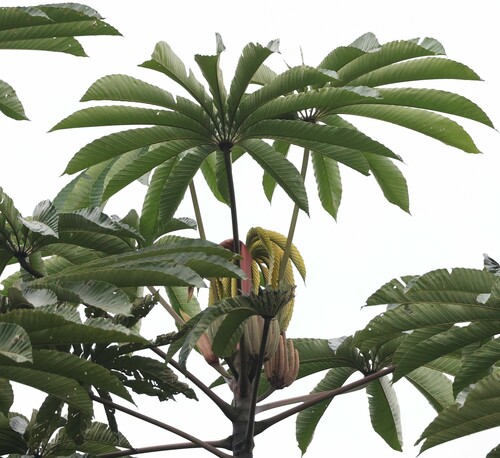
(c) Kathy Richardson, some rights reserved (CC BY), uploaded by Kathy Richardson
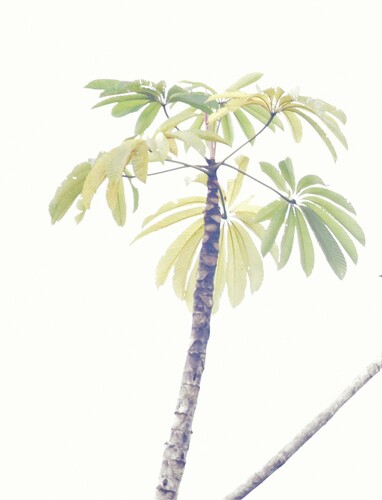
(c) Zac Peterson, some rights reserved (CC BY)
What to Eat
Edible parts: Fruit, Leaves - flavouring, Roots - drink
The fruits are eaten, the leaves are used as a flavouring (ash of leaves flavours coca), and water is extracted from the roots for drinking.
Known Hazards
Where to Find It
It is a tropical plant. It grows in open areas in primary forest. It is often along streams.
Amazon, Andes, Bolivia, Brazil, Colombia, Ecuador, Guianas, Guyana, Peru, South America*, Suriname, Venezuela,
How to Identify
An evergreen tree. It grows 30 m tall. It has a sparse open crown. The trunk is 20-30 cm across. Male and female flowers are on separate plants. The fruit are finger shaped.
How to Grow
Plants can be grown from seeds. The seeds need light to germinate. Seeds sprout in 2-3 weeks. Plants can be grown from cuttings.
Propagation: Seed - requires light to germinate. It can be sown in light shade in a nursery seedbed, but should not be covered, just lightly pressed into the soil. A medium rate of germination can be expected, with the seeds sprouting within 2 - 3 weeks. Greenwood cuttings in a frame with bottom heat.
Medicinal Uses
Water extracted from the roots is used as a drink.
Other Uses
The bark is squeezed in water to make a preparation that is used to stupefy wasps. The wood is of medium texture, soft, light in weight, not very durable, and easy to work. It is used for low value items such as boxes, linings, matchsticks etc. Traditionally, it has been used to make rafts, whilst it is also pulped for cellulose. With their sparse canopy and attractive foliage that is green above and silver-felted below, members of this genus generally provide a dramatic canopy but only cast a very light shade, allowing other plants to be grown right up to the base of their trunk. Many members of the genus can be used as pioneer species when developing a new woodland.
Wikipedia
Source ↗Cecropia sciadophylla is a plant species from the genus Cecropia. The species was originally described by Carl Friedrich Philipp von Martius in 1841.
Notes
Also put in the families Moraceae and Cecropiaceae.
Names & Synonyms
Ambaibo, Cetico, Dondofa, Guarumba, Guarumo, Hormiguero, Kahu usihi, Mamnimewe, Mangimeo, Mangimeowe, Mannebe, Manwibe, Pattaga, Purma cetico, Sarahuaque, Uvilla, Wana-soro, Yantan
References (7)
- Fern, K., 2012, Tropical Species Database http://theferns.info/tropical/
- Grandtner, M. M. & Chevrette, J., 2013, Dictionary of Trees, Volume 2: South America: Nomenclature, Taxonomy and Ecology. Academic Press p 113
- Kermath, B. M., et al, 2014, Food Plants in the Americas: A survey of the domesticated, cultivated and wild plants used for Human food in North, Central and South America and the Caribbean. On line draft. p 202
- Lopez-Diago, D. & Garcia, N., 2021, Wild edible fruits of Colombia. Biota ColomBiana 22 (2) p 53
- Roa, J. A. G. & Boada, D. S. G., 2018, Fundación para el Fortalecimiento de la Fruticultura y Plantas Alimenticias no Convencionales en Colombia.
- Torre, de la, L., et al, 2008, Enciclopedia de las Plantas Útiles del Ecuador. Herbario QCA. Pontificia Universidad Católica del Ecuador. p 607
- www.proyanomami.org


