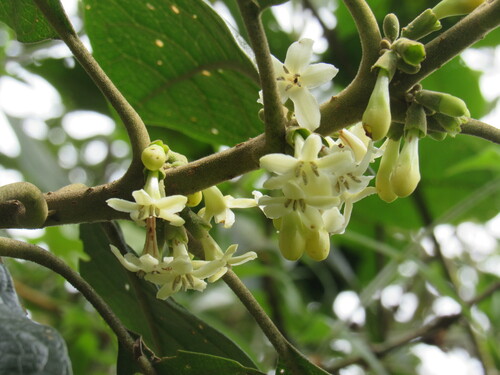
Plectranthus parviflorus
Willd.
Sudan potato

(c) toohey-forest-wildlife, some rights reserved (CC BY-NC)

(c) robgiii, some rights reserved (CC BY-NC)

(c) PeterCopping, some rights reserved (CC BY-NC)
What to Eat
Edible parts: Leaves, Roots
The tubers are boiled or baked like potatoes and eaten as a vegetable. The leaves are also eaten.
Where to Find It
It is a tropical plant. It grows in drier areas. Plants can produce with 100 mm of rainfall.
Africa, Asia, Australia, Hawaii, Malaysia, Pacific, SE Asia,
How to Identify
A herb or shrub that grows from a tuberous rootstock. It can be 20 cm to 1 m tall. The leaves are 1-3 cm long by 1-4 cm wide. They have large teeth along the edge. Leaves are hairy. The flowering shoots are 30 cm long. They flowers are 4-5 mm across and in rings of six. The fruit are 4-5 mm long.
How to Grow
Plants can be grown from seeds. They can also be grown from cuttings 10-20 cm long and by division of the sprouting tubers.
Propagation: Seed - not normally used for propagation. Cuttings about 10 - 20cm long. Division of sprouting tubers.
Medicinal Uses
A poultice of the leaves, or a wash made from an infusion of them, is used as a treatment for syphilitic sores. The plant has been shown to contain compounds that inhibit HIV-1 integrase.
Other Uses
Plants easily reseed themselves around the mother plant. They can easily be re-planted to other locations or be allowed to remain to form a loose groundcover.
Production
Tubers are ready 4-5 months after planting. Yields of 4-7 tonnes per hectare are possible.
Other Information
It is cultivated.
Names & Synonyms
References (3)
- Fern, K., 2012, Tropical Species Database http://theferns.info/tropical/
- Lukhoba, C. W., et al, 2006, Plectranthus: A review of ethnobotanical uses. Journal of Ethnopharmacology 103 (2006) 1–24
- Zeven, A. C. & de West, J. M. J., 1982, Dictionary of cultivated plants and their regions of diversity. Wageningen. p 56 (As Coleus parviflorus)