Bambusa nutans
Wall. ex Munro
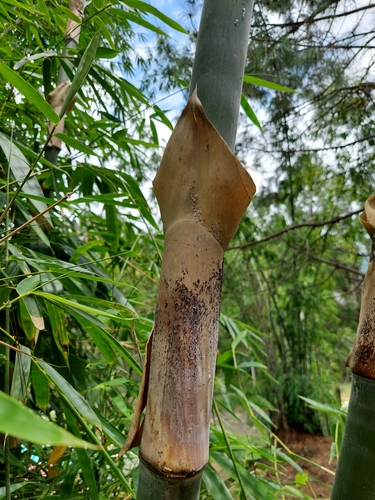
(c) Phuentsho, some rights reserved (CC BY-NC), uploaded by Phuentsho
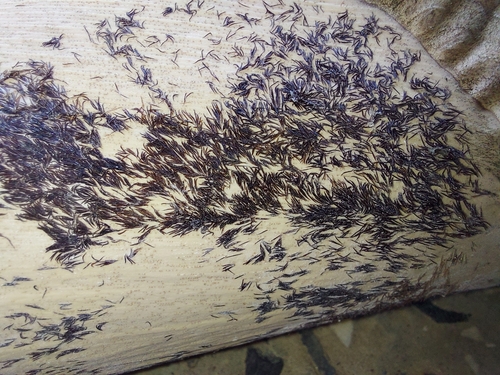
(c) Phuentsho, some rights reserved (CC BY-NC)
What to Eat
Edible parts: Shoots
Edible Parts: Shoots Edible Uses: Edible portion: Shoots. Shoots - cooked.
Where to Find It
It is a tropical plant.
Asia, Australia, Bangladesh, Bhutan, China, Himalayas, India, Indochina, Laos, Nepal, Northeastern India, SE Asia, Sikkim, Thailand, Vietnam,
How to Identify
A bamboo. It grows 10-15 m tall. The stems are 8 cm across. They form loose clumps. The stems are smooth and green with a white ring below the nodes. The nodes are slightly thickened and often hairy. The internodes are 25-45 cm long and the walls are thick. The sheaths are 10-23 cm long and 30 cm wide at the base.
Nutrition Score: 1/100
| Part | Moisture | kJ | kcal | Protein | Vit A | Vit C | Iron | Zinc |
|---|---|---|---|---|---|---|---|---|
| Seeds | — | — | 4.5 | — | — | — | — | — |
How to Grow
It grows best in areas where annual daytime temperatures are within the range 22 - 28c, but can tolerate 9 - 32c. It prefers a mean annual rainfall in the range 2,300 - 3,000mm, but tolerates 700 - 4,500mm. Succeeds in full sun and in dappled shade. Grows best in a fertile, heavy soil. Prefers a pH in the range 6 - 7, tolerating 5.5 - 7.5. Bamboos have an interesting method of growth. Each plant produces a number of new stems annually - these stems grow to their maximum height in their first year of growth, subsequent growth in the stem being limited to the production of new side branches and leaves. In the case of some mature tropical species the new stem could be as much as 30 metres tall, with daily increases in height of 30cm or more during their peak growth time. This makes them some of the fastest-growing species in the world. Bamboos in general are usually monocarpic, living for many years before flowering, then flowering and seeding profusely for a period of 1 - 3 years before usually dying.
Propagation: Seed
Medicinal Uses
None known
Other Uses
Biomass Fencing Fibre Paper Shelterbelt Wood Other uses rating: High (4/5). Agroforestry Uses: The plant is sometimes used to provide shelter for tea plantations. Other Uses The culm is good, strong, straight. It is used locally for various purposes, mainly as poles. It is a major source of fibre for the paper industry in India. Special Uses Carbon Farming Food Forest
Wikipedia
Fast-growing evergreen bamboo reaching 12 m tall with a 5 m spread. Hardy to UK zone 10. Tolerates light sandy, medium loamy, and heavy clay soils with good drainage. Grows in mildly acid to basic pH ranges. Suitable for semi-shade or full sun, prefers moist conditions. Wind-pollinated with wind tolerance, though not suitable for maritime exposure.
Other Information
It is cultivated.
Names & Synonyms
Bansh, Bidhuli, Deobans, Homeng, Jotia-makal, Kali, Mahi bans, Mahlu, Mai bong, Mallo, Mukial, Peechli, Phai bong ban, Saneibi, Seringjai, Wah mi, Wa-malang
References (11)
- A Rapid Participatory Biodiversity Assessment. 2007, Southern Lao PDR. IUCN p 104
- Balkrishna, A., et al, 2022, Indigenous Uses of Plants among Forest-dependent Communities of Seijosa, Arunachal Pradesh. International Journal of Economic Plants 2022, 9(1):064-080
- BARC, 2016, State of Biodiversity for Food and Agriculture in Bangladesh. Bangladesh Agricultural Research Council.
- Devi, O. S., et al, 2021, Wild edible plants associated with the people of Thoubal Khunou village and its migrated villagers. Int. J. Adv. Res. Biol. Sci. 8(9): 72-90
- Lungphi, P., Wangpan, T. & Tangjang, S., 2018, Wild edible plants and their additional uses by the Tangsa community living in the Changlang district of Arunachal Pradesh, India. Pleione 12(2): 151 - 164. 2018.
- Premlata, T., et al, 2020, Edible bamboo resources of Manipur: consumption pattern of young shoots, processing techniques and their commercial status in the local market. Indian Journal of Traditional Knowledge Vol. 19(1) pp 73-82
- Singh, P., et al, 2019 Plants of Indian Himalayan region. Part 1 Botanical Surbey of India. p 32
- Srichaiwong, P., et al, 2014, A Study of the Biodiversity of Natural Food Production to Support Community Upstream of Chi Basin, Thailand. Asian Social Science 10 (2):
- Sundriyal, M. & Sundriyal, R. C., 2004, Structure, Phenology, Fruit Yield, and Future Prospects of some Prominent Wild Edible Plant Species of the Sikkim Himalaya, India. Journal of Ethnobiology 24(1): 113-138
- Upreti, T.C. and Sundriyal, R. C., 2001, Bamboo and cane resources of Arunachal Pradesh: Utilization pattern and implications for management. Bamboo Science and Culture: The Journal of the American Bamboo Society 15(1):20-34
- Waikhom, S. D., et al, 2013, Grappling the High Altitude for Safe Edible Bamboo Shoots with Rich Nutritional Attributes and Escaping Cyanogenic Toxicity. BioMed Reserch International. Voluyme 2013 Article ID 289285, 11 pages


