Amorphophallus prainii
Hook.f.

iNaturalist · cc-by-nc
(c) margaret888, some rights reserved (CC BY-NC)
(c) margaret888, some rights reserved (CC BY-NC)
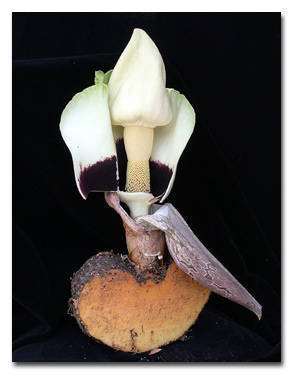
iNaturalist · cc-by-nc-sa
(c) Smithsonian Institution, National Museum of Natural History, Department of Botany, some rights reserved (CC BY-NC-SA)
(c) Smithsonian Institution, National Museum of Natural History, Department of Botany, some rights reserved (CC BY-NC-SA)
What to Eat
Edible parts: Corms, Roots
The corms and roots are edible and the plant is occasionally cultivated for this purpose.
Known Hazards
Where to Find It
It is a tropical plant. It grows in lowland rainforest.
Asia, India, Indonesia, Laos, Malaysia, SE Asia,
Countries: United Arab Emirates, Afghanistan, Armenia, Azerbaijan, Bangladesh, Bahrain, Brunei, Bhutan, China, Georgia, Indonesia, Israel, India, Iraq, Iran, Jordan, Japan, Kyrgyzstan, Cambodia, North Korea, South Korea, Kuwait, Kazakhstan, Laos, Lebanon, Sri Lanka, Myanmar, Mongolia, Maldives, Malaysia, Nepal, Oman, Philippines, Pakistan, Qatar, Saudi Arabia, Singapore, Syria, Thailand, Tajikistan, Timor-Leste, Turkmenistan, Turkey, Taiwan, Uzbekistan, Vietnam, Yemen
How to Identify
A taro family herb. It grows up to 40 cm tall. It produces a single leaf from the tuber. The tuber is 25 cm across.
Other Information
It is occasionally cultivated for its edible corms.
Names & Synonyms
Amorphophallus loerzingii Alderw.Amorphophallus panomensis Gagnep.
References (2)
- Mansfeld,
- Sanchez-Monge, 1991,


