Leea compactiflora
Kurz
VitaceaeLeaves
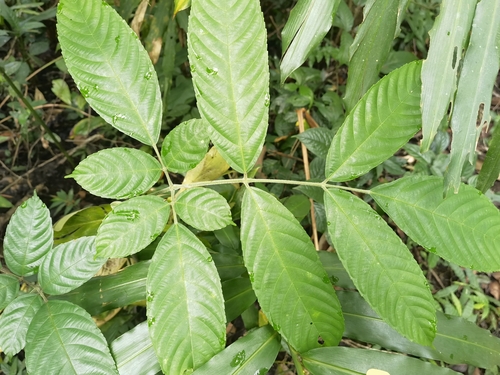
iNaturalist · cc-by-nc
(c) xinyujia, some rights reserved (CC BY-NC)
(c) xinyujia, some rights reserved (CC BY-NC)
What to Eat
Edible parts: Leaves
The leaves are eaten.
Where to Find It
It is a tropical plant. It grows in valleys between 600-2,200 m above sea level in southern China. In Yunnan.
Asia, Bangladesh, Bhutan, China, Himalayas, India, Laos, Myanmar, Northeastern India, SE Asia, Tibet, Vietnam,
Countries: United Arab Emirates, Afghanistan, Armenia, Azerbaijan, Bangladesh, Bahrain, Brunei, Bhutan, China, Georgia, Indonesia, Israel, India, Iraq, Iran, Jordan, Japan, Kyrgyzstan, Cambodia, North Korea, South Korea, Kuwait, Kazakhstan, Laos, Lebanon, Sri Lanka, Myanmar, Mongolia, Maldives, Malaysia, Nepal, Oman, Philippines, Pakistan, Qatar, Saudi Arabia, Singapore, Syria, Thailand, Tajikistan, Timor-Leste, Turkmenistan, Turkey, Taiwan, Uzbekistan, Vietnam, Yemen
How to Identify
A shrub. The small branches have ridges along them. They have rusty hairs when young. The leaves have 2 or 3 leaflets along the stalk. The leaflets are narrow and 12-23 cm long by 3-9 cm wide. There are irregular teeth along the edge. The flowering shoots are opposite the leaves. The fruit is a flattened round shape and 1 cm across. There are 4-6 seeds.
Notes
Also put in the family Leeaceae.
Names & Synonyms
Kum-tin-tuai
References (1)
- Kar, A., et al, 2013, Wild Edible Plant Resources used by the Mizos of Mizoram, India. Kathmandu University Journal of Science, Engineering and Technology. Vol. 9, No. 1, July, 2013, 106-126


