Piper diffusum
Blume ex Miq.

lichenostomus

KW

Claudje
What to Eat
Edible parts: Fruit - spice
Piper sarmentosum leaves are sold in bunches and are usually eaten raw. In Chinese cuisine, the chopped leaves are a primary ingredient in the dish of wild betel rice (蛤蒌饭) from Zhanjiang in Guangdong province. It is also used in herbal remedies of traditional Chinese medicine. In Bangladeshi cuisine, chopped leaves are tossed with chopped onion, green chili and a dash of mustard oil to be eaten as a salad with plain rice. In Thai cuisine, the leaves are used to wrap miang kham, a traditional snack; they are also one of the ingredients of the Kaeng khae curry of Northern Thailand. The curry is named after these leaves, which are known as khae in Northern Thailand. In Laotian cuisine, it is eaten as part of a salad. In Malay cuisine it is shredded for ulam, a type of Malay salad. In Vietnamese cuisine it is grilled in bò nướng lá lốt, a typical Southern Vietnamese dish. Minced beef is marinated with seasoning, soya sauce and various finely chopped spices such as garlic, onion and lemongrass then wrapped in Piper lolot leaves and grilled, which brings smokey flavor to the beef. It is served with rice noodles, fresh herbs, sliced star fruits and pineapples, and fermented fish sauce mắm nêm The practice of wrapping meat in vine leaves originated in the Middle East, which was taken to India by the Persians. It was subsequently introduced by the Indians to Southeast Asia. However, grape vines do not grow well in tropical climates, so the Vietnamese started to use leaves of lolot instead. It is native to the Indochinese region and recently introduced to the United States by Lao and Vietnamese immigrants.
Where to Find It
It is a tropical plant.
Asia, India, Myanmar, Northeastern India, SE Asia,
How to Identify
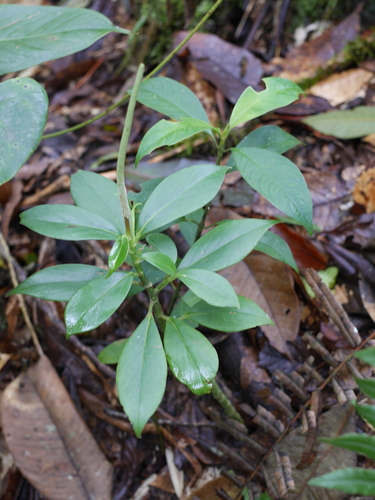
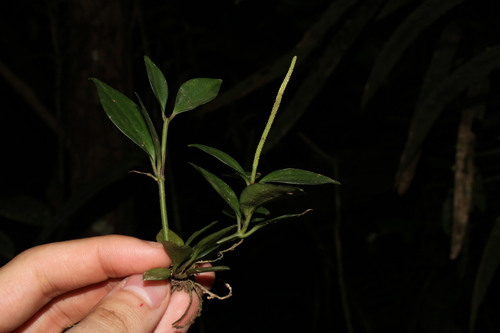
A stout tropical climber in the Piperaceae family that spreads as a herb, forming roots at the nodes as it grows.
Medicinal Uses
Piper sarmentosum leaves are used in traditional Asian medicines. Chemical analysis has shown the leaves contain the antioxidant naringenin. Amides from P. sarmentosum fruit have been shown to have anti-tuberculosis and anti-plasmodial activities. It was tested against various bacteria species such as Staphylococcus aureus, Escherichia coli, Vibrio cholerae and Streptococcus pneumoniae in 2010.
Names & Synonyms
Hnak-thak, Murit, Pawhrual, Soh-myret
References (2)
- Kar, A., et al, 2013, Wild Edible Plant Resources used by the Mizos of Mizoram, India. Kathmandu University Journal of Science, Engineering and Technology. Vol. 9, No. 1, July, 2013, 106-126
- Phawa, G. M., Dkhar, E. K. & Marbaniang, D., 2019, Indigenous Wild Edible Plants of Bataw Village, East Jaintia Hills District, Meghalaya. International Journal of Arts, Science and Humanities. 7(2) (As Vahl.)