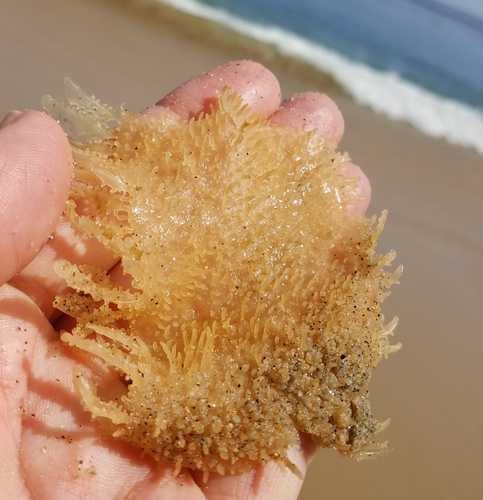
Chondrus ocellatus
Holmes
Makuri-nori
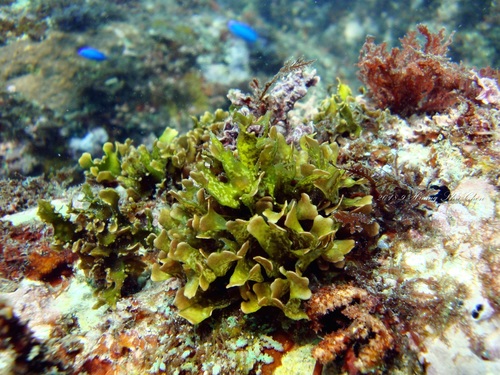
iNaturalist · cc-by-nc
(c) 黃淑真, some rights reserved (CC BY-NC), uploaded by 黃淑真
(c) 黃淑真, some rights reserved (CC BY-NC), uploaded by 黃淑真
What to Eat
Edible parts: Algae, Frond, Seaweed
The fronds are eaten raw as seaweed.
Where to Find It
It is a temperate plant. It grows on rocks in the inter-tidal zone often in sheltered places.
Alaska, Asia, Canada, China, Hawaii, Japan, Korea, North America, USA,
Countries: United Arab Emirates, Afghanistan, Antigua & Barbuda, Armenia, Azerbaijan, Barbados, Bangladesh, Bahrain, Brunei, Bahamas, Bhutan, Belize, Canada, China, Costa Rica, Cuba, Dominica, Dominican Republic, Grenada, Georgia, Guatemala, Honduras, Haiti, Indonesia, Israel, India, Iraq, Iran, Jamaica, Jordan, Japan, Kyrgyzstan, Cambodia, St Kitts & Nevis, North Korea, South Korea, Kuwait, Kazakhstan, Laos, Lebanon, St Lucia, Sri Lanka, Myanmar, Mongolia, Maldives, Mexico, Malaysia, Nicaragua, Nepal, Oman, Panama, Philippines, Pakistan, Puerto Rico, Qatar, Saudi Arabia, Singapore, El Salvador, Syria, Thailand, Tajikistan, Timor-Leste, Turkmenistan, Turkey, Trinidad & Tobago, Taiwan, United States, Uzbekistan, St Vincent, Vietnam, Yemen
How to Identify
A seaweed of the Gigartinaceae family found in temperate regions on rocks in the intertidal zone, often in sheltered locations.
References (8)
- http://www.seavegetables.com
- Hu, Shiu-ying, 2005, Food Plants of China. The Chinese University Press. p 260
- Kiple, K.F. & Ornelas, K.C., (eds), 2000, The Cambridge World History of Food. CUP p 236
- Subba Rao, G.N., 1965, Uses of seaweed directly as human food. Indo-Pacific Fisheries Council Regional Studies 2:1-32
- Tseng, C.K., 1983, Common seaweeds of China. Beijing.
- Xia, B., and Abbott, I.A., 1987, Edible seaweeds of China and their place in the Chinese diet. Economic Botany 41:341-53
- www.algaebase.org
- Zemke-White, W. L. & Ohno, M., 1999, World seaweed utilisation: An end-of-century summary. Journal of Applied Phycology 11: 369-376