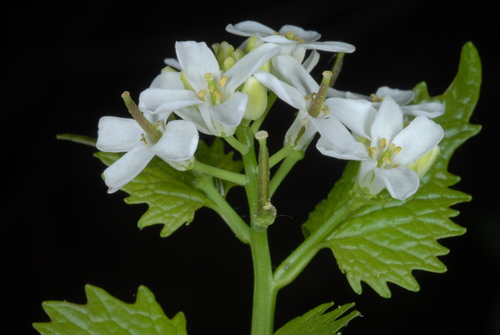
Chorispora sabulosa
Cambess.
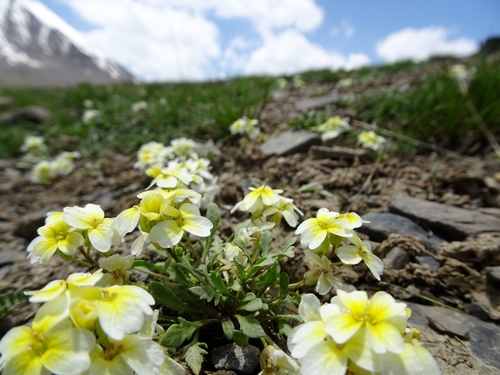
(c) Jasmine Star Outdoor Photography, some rights reserved (CC BY-NC), uploaded by Jasmine Star Outdoor Photography
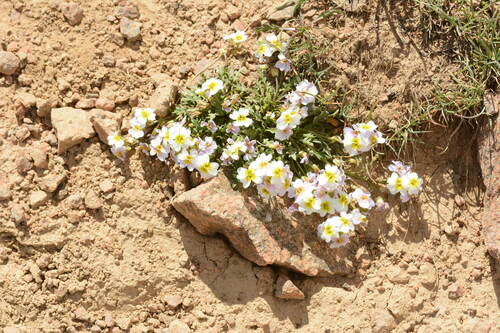
(c) Pavel Gorbunov, some rights reserved (CC BY-NC)
What to Eat
Edible parts: Fruit, Leaves, Stems
The fruit is edible. No further details are available.
Where to Find It
It is a temperate plant. It grows in mountain slopes between 2900–4800 m altitude in China. It grows on stony slopes and is common in dry areas.
Afghanistan, Asia, Central Asia, Europe, Himalayas, India, Kashmir, Kazakhstan, Korea, Kyrgyzstan, Mongolia, Pakistan, Russia, Tajikistan, Tibet, Turkmenistan, Uzbekistan, N Africa, SW Asia,
How to Identify
A cabbage family herb. It is a small plant with a ring of leaves near the ground. It keeps growing from year to year. The leaves are narrow and have narrow lobes along the stalk. The leaves are 2-6 cm long. They are rounded sword shape in outline with a round lobe at the end. The side lobes are blunt and hairy. The stems are short and the flowers are in loose clusters. The flowers are pink, violet or white. The flowers are 1 cm across. The petals are 6-10 mm long and have shallow notches. The fruit are about 1.5 cm long and rounded. They are hairy and constricted between the seeds.
How to Grow
Succeeds in ordinary garden soil.
Propagation: Sow seed in early spring in a greenhouse. When seedlings are large enough to handle, prick them out into individual pots and grow on under glass for at least their first winter. Plant out into permanent positions in late spring or early summer, after the last expected frosts.
Medicinal Uses
No medicinal uses are known for this plant.
Other Uses
No other uses are known for this plant.
Wikipedia
Source ↗Chorispora sabulosa is a species of flowering plant in the genus Chorispora. It is a perennial native to subalpine regions of Central Asia, northern Pakistan, the western Himalayas, and Tibet.
Names & Synonyms
Sha sheng li zi jie
References (5)
- Flora of China @ efloras.org Volume 8
- Plants for a Future database, The Field, Penpol, Lostwithiel, Cornwall, PL22 0NG, UK. http://www.scs.leeds.ac.uk/pfaf/
- Polunin, O., & Stainton, A., 2006, Flowers of the Himalaya, Oxford India Paperbacks. p 42 (Photo) Pl 15
- Sharma, L. et al, 2018, Diversity, distribution pattern, endemism and indigenous uses of wild edible plants in Cold Desert Biosphere Reserve of Indian Trans Himalaya. Indian Journal of Traditional Knowledge. Vol 17(1) January 2018 pp 122-131
- Zhou Taiyan, Lu Lianli, Yang Guang; Ihsan A. Al-Shehbaz, BRASSICACEAE (CRUCIFERAE), Flora of China.