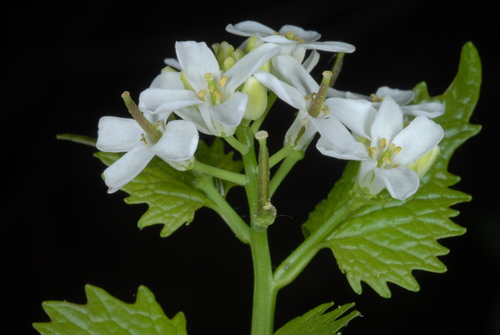
Chorispora tenella
(Pallas) DC.
Musk mustard, Loose seed herb, Crossflower

(c) Zaxy, some rights reserved (CC BY-NC-ND)
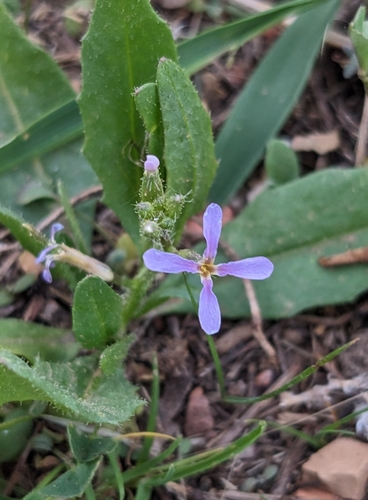
(c) Adam Holder, some rights reserved (CC BY-NC)
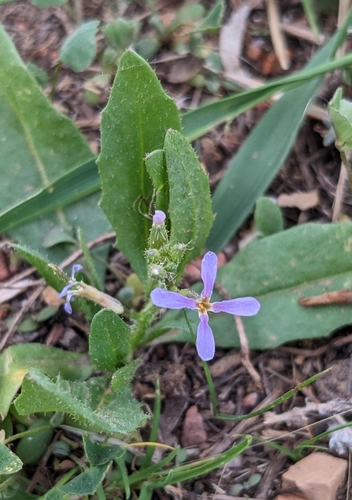
(c) Adam Holder, some rights reserved (CC BY-NC)
What to Eat
Edible parts: Leaves
The leaves can be eaten raw or cooked, making a good early-season salad green.
Where to Find It
It grows in pastures, roadsides, fields, waste areas between 100–2200 m altitude in China.
Afghanistan, Africa, Asia, China, Central Asia, Europe, India, Kashmir, Kazakhstan, Korea, Kyrgyzstan, Mongolia, North Africa, North America, Pakistan, Russia, Tajikistan, Turkmenistan, USA, Uzbekistan, SW Asia,
How to Identify
A cabbage family herb. It is an annual plant up to 40 cm tall. It is hairy. The leaves at the base and on the lower stem are broadly oval with lobes along the side. They are 3-4 cm long by 3-5 mm wide. The leaves in the stems do not have leaf stalks. They have teeth. The flowers are lavender and small. They are 3 mm long. The pods are cylinder shaped and 3-5 cm long and slightly curved. They have a beak. The seeds are oblong and 1.5 mm long. They are light brown.
Nutrition Score: 39/100
| Part | Moisture | kJ | kcal | Protein | Vit A | Vit C | Iron | Zinc |
|---|---|---|---|---|---|---|---|---|
| Leaves - boiled | 92.5 | 84 | 20 | 1.6 | 505 | 24 | 3.7 | 0.2 |
How to Grow
Propagation: Propagation is exclusively by seed. Seeds germinate readily in cool conditions following rainfall or irrigation, and plants produce large numbers of seeds, ensuring reliable reappearance in suitable habitats year after year.
Medicinal Uses
No medicinal uses are known for this plant.
Other Uses
No other uses are known for this plant.
Wikipedia
Source ↗Chorispora tenella is a species of flowering plant in the mustard family known by several common names, including purple mustard, blue mustard, musk mustard, and crossflower. This mustard is native to parts of Eurasia but is well known in other parts of the world, particularly in temperate regions, as an introduced species and a noxious weed.
Names & Synonyms
References (9)
- Flora of China @ efloras.org Volume 8
- Hedrick, U.P., 1919, (Ed.), Sturtevant's edible plants of the world. p 187
- Hu, Shiu-ying, 2005, Food Plants of China. The Chinese University Press. p 416
- Plants for a Future database, The Field, Penpol, Lostwithiel, Cornwall, PL22 0NG, UK. http://www.scs.leeds.ac.uk/pfaf/
- Syst. nat. 2:435. 1821
- Urgamal, M., Oyuntsetseg, B., Nyambayar, D. & Dulamsuren, Ch. 2014. Conspectus of the vascular plants of Mongolia. (Editors: Sanchir, Ch. & Jamsran, Ts.). Ulaanbaatar, Mongolia. “Admon“ Press. 334pp. (p. 79-90).
- USDA, ARS, National Genetic Resources Program. Germplasm Resources Information Network - (GRIN). [Online Database] National Germplasm Resources Laboratory, Beltsville, Maryland. Available: www.ars-grin.gov/cgi-bin/npgs/html/econ.pl (10 April 2000)
- World Checklist of Useful Plant Species 2020. Royal Botanic Gardens, Kew
- Zhou Taiyan, Lu Lianli, Yang Guang; Ihsan A. Al-Shehbaz, BRASSICACEAE (CRUCIFERAE), Flora of China.