Elaeagnus difficilis
Servettaz
ElaeagnaceaeFruit

gbif · cc0
President and Fellows of Harvard College
President and Fellows of Harvard College

gbif · cc0
President and Fellows of Harvard College
President and Fellows of Harvard College

gbif · cc0
President and Fellows of Harvard College
President and Fellows of Harvard College
What to Eat
Edible parts: Fruit
The fruit is eaten.
Where to Find It
It is a subtropical plant. In southern China it grows between 600-1,800 m above sea level.
Asia, China,
Countries: United Arab Emirates, Afghanistan, Armenia, Azerbaijan, Bangladesh, Bahrain, Brunei, Bhutan, China, Georgia, Indonesia, Israel, India, Iraq, Iran, Jordan, Japan, Kyrgyzstan, Cambodia, North Korea, South Korea, Kuwait, Kazakhstan, Laos, Lebanon, Sri Lanka, Myanmar, Mongolia, Maldives, Malaysia, Nepal, Oman, Philippines, Pakistan, Qatar, Saudi Arabia, Singapore, Syria, Thailand, Tajikistan, Timor-Leste, Turkmenistan, Turkey, Taiwan, Uzbekistan, Vietnam, Yemen
How to Identify
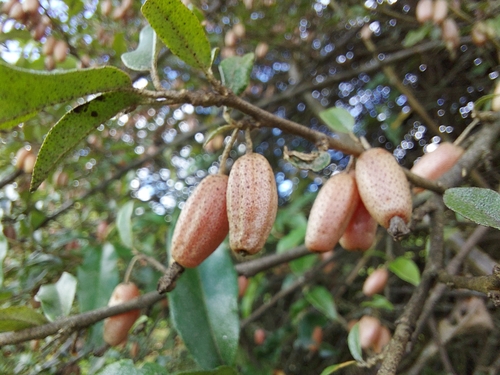
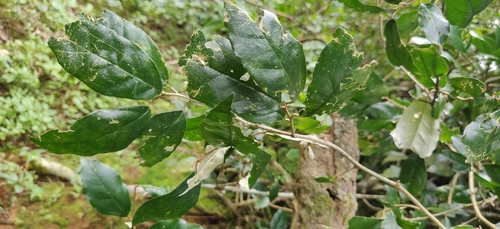
An evergreen shrub. It grows 2-3 m tall. It can be spreading. The side branches have spines at the tips. The leaves are sword shaped and 7-14 cm long by 2-6 cm wide. The flowers are in groups of 1-5 in the axils of new side shoots. The flowers are nodding and tube shaped. The fruit are orange to red and cylinder shaped. They are 1-2 cm long by 6-9 mm aide. They have 8 ribs.
Production
In China plants flower in April and fruit in May to June.
Names & Synonyms
Tiu ching tsz tang
Elaeagnus cuprea RehderElaeagnus difficilis var. brevistyla W. K. Hu & H. F. ChowElaeagnus difficilis var. difficilis
References (1)
- Reis, S. V. and Lipp, F. L., 1982, New Plant Sources for Drugs and Foods from the New York Botanical Garden herbarium. Harvard. p 203 (As Elaeagnus cuprea)