Dipodium variegatum
M. A. Clem. & D. L. Jones
Blotched hyacinth-orchid, Spotted hyacinth orchid
OrchidaceaeRoots
iNaturalist · cc-by-nc
(c) johneichler, some rights reserved (CC BY-NC), uploaded by johneichler
(c) johneichler, some rights reserved (CC BY-NC), uploaded by johneichler
iNaturalist · cc-by-nc
(c) Sandy, some rights reserved (CC BY-NC)
(c) Sandy, some rights reserved (CC BY-NC)

iNaturalist · cc-by-nc
(c) izakschoon, some rights reserved (CC BY-NC), uploaded by izakschoon
(c) izakschoon, some rights reserved (CC BY-NC), uploaded by izakschoon
What to Eat
Edible parts: Roots, Rhizome
The fleshy roots and rhizomes are eaten.
How to Identify
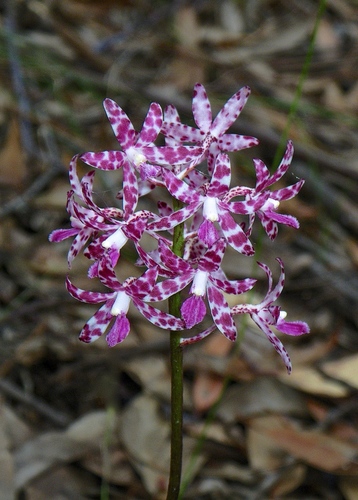
A slender leafless ground orchid. It has thick roots and grows 25 cm tall. The flowers are at the end of the stalk. They are creamy white to pinkish-red. The fruit is a capsule.
Wikipedia
Source ↗Dipodium variegatum, commonly known as the slender hyacinth-orchid, or blotched hyacinth-orchid, is a leafless mycoheterotrophic orchid that is endemic to south-eastern Australia. It forms mycorrhizal relationships with fungi of the genus Russula.
References (3)
- Caton, J.M. & Hardwick, R. J., 2016, Field Guide to Useful Native Plants from Temperate Australia. Harbour Publishing House. p 94
- Lim, T. K., 2015, Edible Medicinal and Non Medicinal Plants. Volume 9, Modified Stems, Roots, Bulbs. Springer p 39
- Melzer, R. & Plumb, J., 2011, Plants of Capricornia. Belgamba, Rockhampton. p 500