Cimicifuga simplex
(DC.) Wormsk. ex Turcz.
Saiashina-shoma
(c) onidiras-iNaturalist, some rights reserved (CC BY-NC)

(c) onidiras-iNaturalist, some rights reserved (CC BY-NC)

(c) onidiras-iNaturalist, some rights reserved (CC BY-NC)
What to Eat
Edible parts: Leaves
Leaves can be eaten cooked, though some caution is advised given the plant's noted toxicity. The fragrant root is used as a spice.
Where to Find It
It is a temperate plant. It is frost hardy. In China it grows on the edges of forests and on grassy slopes between 300-3,200 m above sea level. In Sichuan.
Asia, China, Japan, Dahurica, Korea, Mongolia, Russia, Siberia, Taiwan,
How to Identify
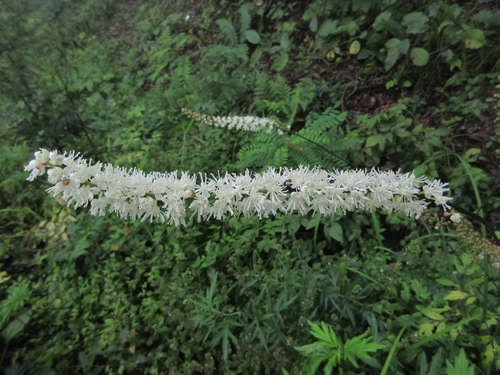
A perennial herb. It grows 90-120 cm high and 50-60 cm wide. The flowers are narrow and white.
How to Grow
Propagation: Seed is best sown as soon as it is ripe in a cold frame, barely covered. Germination occurs in 1–12 months or longer at 15°C. Seed does not store well and quickly loses viability; stored seed may germinate better after 6–8 weeks of warm stratification at 15°C followed by 8 weeks of cold stratification. Prick out seedlings into individual pots when large enough and grow on in a frame through their first winter, then plant out in late spring or early summer. Divide in spring or autumn — larger clumps can go directly into permanent positions, while smaller clumps are best potted up and grown on in a cold frame until rooting well, then planted out in summer or the following spring.
Medicinal Uses
None known.
Other Uses
None known.
Wikipedia
Source ↗A perennial reaching 1.5 m tall by 0.6 m wide. Hardy to UK zone 5. Flowers in October with seed ripening October to November. Hermaphroditic flowers pollinated by bees, moths, and butterflies. Noted for attracting wildlife. Grows in light, medium, or heavy soils with good drainage. Tolerates semi-shade in light woodland and prefers moist soil. Adapts to mildly acidic through basic soil pH.
Notes
There are about 18 Cimicifuga species.
Names & Synonyms
References (5)
- Bull. Soc. Imp. Naturalistes Moscou 15(1):87. 1842 (A. P. de Candolle, Prodr. 1:64. 1824, pro syn.)
- Facciola, S., 1998, Cornucopia 2: a Source Book of Edible Plants. Kampong Publications, p 189
- Joyce, D., 1998, The Garden Plant Selector. Ryland, Peters and Small. p 217
- Plants for a Future database, The Field, Penpol, Lostwithiel, Cornwall, PL22 0NG, UK. http://www.scs.leeds.ac.uk/pfaf/
- Tanaka,


