Trollius chinensis
Bunge
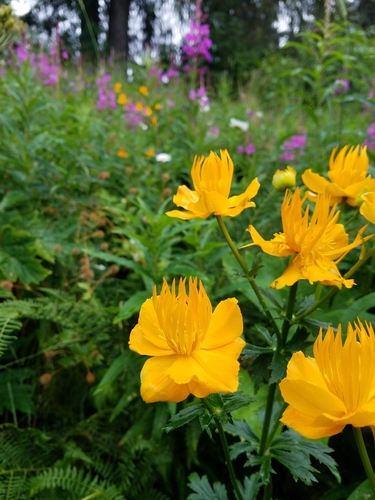
(c) mustardlypig, some rights reserved (CC BY-NC), uploaded by mustardlypig
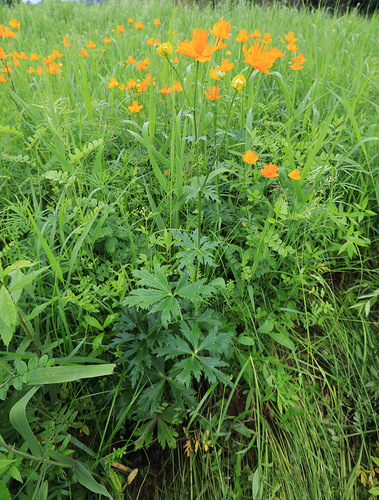
(c) V.S. Volkotrub, some rights reserved (CC BY-NC), uploaded by V.S. Volkotrub

(c) Svetlana Nesterova, some rights reserved (CC BY-NC), uploaded by Svetlana Nesterova
What to Eat
Edible parts: Flowers
The flowers are eaten.
Where to Find It
It is a temperate plant.
Asia, China, Korea, Mongolia, Russia,
How to Identify
A herb. It keeps growing from year to year. It forms clumps. It grows 90 cm tall. The leaves have lobes like fingers on a hand. The flowers are yellow or golden and have several petal like sepals.
Medicinal Uses
Described as having antioxidant properties.
Wikipedia
Source ↗Trollius chinensis, the Chinese globeflower, is a species of flowering plant in the family Ranunculaceae, found from southern Siberia to the southern Russian Far East, Sakhalin, the Kurils, Mongolia, Korea, and northern China (to north Henan). Its cultivar 'Golden Queen' has gained the Royal Horticultural Society's Award of Garden Merit.
Notes
It is described as edible and medicinal with antioxidants.
Names & Synonyms
References (3)
- Khasbagan, Yeruhan and Zhao Hui, 2011, Study on Traditional Knowledge of Wild Edible Plants Used by the Mongolians in Xilingol Typical Steppe Area. Plant Diversity and Resources. 33(2): 239-246
- Urgamal, M., Oyuntsetseg, B., Nyambayar, D. & Dulamsuren, Ch. 2014. Conspectus of the vascular plants of Mongolia. (Editors: Sanchir, Ch. & Jamsran, Ts.). Ulaanbaatar, Mongolia. “Admon“ Press. 334pp. (p. 79-90).
- Zeng, Y., et al, 2014, Evaluation of antioxidant activities of extracts from 19 Chinese edible flowers. SpringerPlus 2014, 3:315


