Dendrobium loddigesii
Rolfe

(c) Edward, some rights reserved (CC BY-NC)
(c) Cédric DEL RIO, some rights reserved (CC BY-NC)

(c) Huang Baochen | 黄宝臣, some rights reserved (CC BY-NC)
What to Eat
Edible parts: Flowers
The flowers are edible.
Where to Find It
It is a tropical plant. It grows attached to tree trunks in mountain forests between 400-1,500 m above sea level in southern China. In Yunnan.
Asia, China, Laos, SE Asia, Vietnam,
How to Identify
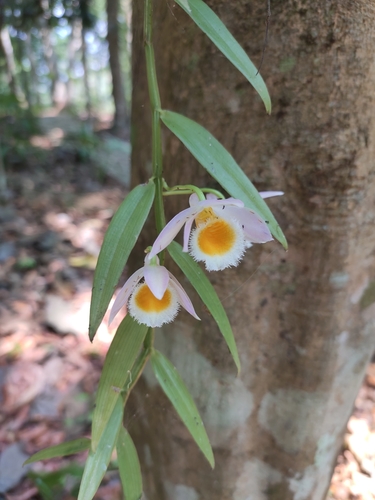
An orchid. The stems often hang down. They are cylinder shaped, slender and 10-45 cm long. The leaves are alternate along the entire stem. They are oblong and 2-4 cm long by 1 cm wide. The flowering stalk comes from the side of the upper part of the old stems. There are 1-2 flowers. The flowers are pale pink or purplish red.
Other Uses
An extract of the leaves and stems is used as an ingredient in commercial cosmetic preparations as an emollient, humectant, skin conditioner and skin protector.
Wikipedia
Source ↗Dendrobium loddigesii (Loddiges' dendrobium) is a miniature to small sized, warm to cold growing epiphyte, lithophyte or terrestrial orchid that comes from Laos, Vietnam, and China. It is found in humid, mossy, mixed and coniferous forests at elevations of 1000 to 1500 meters, in areas with dry winter and a wet spring and summer. The plant has tufted, pendant, subterete, striated, several-noded, white-sheathed stems carrying alternate, fleshy, oblong, acute leaves. Plicatol B is a phenanthrene that can be isolated from the orchid.
Names & Synonyms
References (1)
- Liu, Yi-tao, & Long, Chun-Lin, 2002, Studies on Edible Flowers Consumed by Ethnic Groups in Yunnan. Acta Botanica Yunnanica. 24(1):41-56