Dendrobium moniliforme
(L.) Sw.
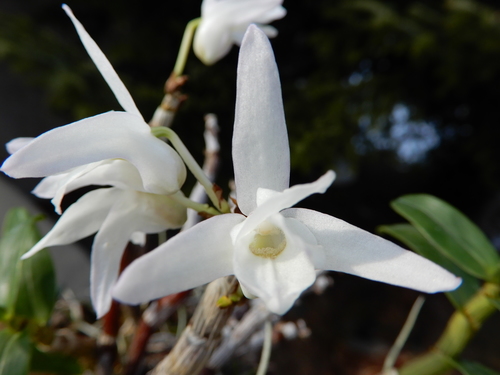
(c) david e leo berton, some rights reserved (CC BY-NC), uploaded by david e leo berton
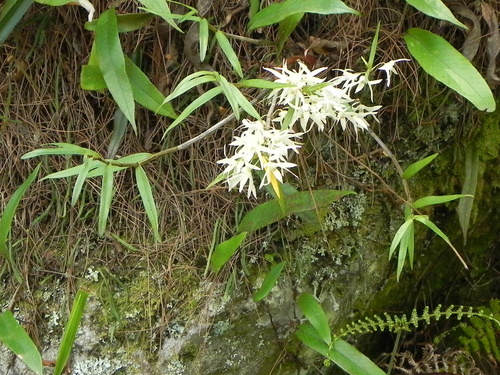
(c) Lijin Huang (紫楝), some rights reserved (CC BY-NC)
What to Eat
Edible parts: Flowers
The flowers are eaten.
Where to Find It
It is a tropical plant. It grows on trees in broad-leaved forests and on rocks in forests and cliffs in valleys between 600-3,000 m above sea level in southern China. In Sichuan and Yunnan.
Asia, Bhutan, China, Himalayas, India, Japan, Korea, Myanmar, Nepal, Northeastern India, SE Asia, Taiwan, Vietnam,
How to Identify
An orchid. It grows on trees. The stems are erect and 10-30 cm long. The leaves are alternate on the stem above the middle. They are oblong and 3-5 cm long by 1 cm wide. There can be one or more flowering stalks. They come from above the middle of old stems. Usually there are 1-3 flowers. The flowers can have a scent. They are yellowish green or pale yellow.
How to Grow
In Nepal this species is found in evergreen broadleaved forests, where the the rainfal is monsoonal, falling mainly from mid June to mid September. The climate of these forests ranges from sub-tropical to warm temperate at higher elevations, winters are warm to mild and frosts are generally few. Epiphyte on Castanopsis indica
Medicinal Uses
Stems are used as a tonic
Other Uses
An extract of the leaves and stems is used as an ingredient in commercial cosmetic preparations as a bleaching agent, humectant, skin conditioner and skin protector.
Wikipedia
Source ↗Dendrobium moniliforme, known as Shihu in Chinese and Sekkoku in Japanese, is a species of orchid. It is native to Japan, Korea, China, the Himalayas, and northern Indochina. Dendrobium moniliforme is the type species for the genus Dendrobium. In 17th century Japan, royalty used it to perfume clothing.
Names & Synonyms
References (1)
- Liu, Yi-tao, & Long, Chun-Lin, 2002, Studies on Edible Flowers Consumed by Ethnic Groups in Yunnan. Acta Botanica Yunnanica. 24(1):41-56