Zingiber striolatum
Diels
ZingiberaceaeFlowers

iNaturalist · cc-by-nc
(c) Chuangzao, some rights reserved (CC BY-NC)
(c) Chuangzao, some rights reserved (CC BY-NC)

iNaturalist · cc-by-nc
(c) Chuangzao, some rights reserved (CC BY-NC)
(c) Chuangzao, some rights reserved (CC BY-NC)

wikimedia · cc-by-sa
Wikimedia Commons - ZengYipe
Wikimedia Commons - ZengYipe
What to Eat
Edible parts: Flowers
The flowers are used as a potherb.
Where to Find It
It is a subtropical plant. It grows in forests and along streams between 300-1,900 m above sea level in southern China. In Sichuan and Yunnan.
Asia, China,
Countries: United Arab Emirates, Afghanistan, Armenia, Azerbaijan, Bangladesh, Bahrain, Brunei, Bhutan, China, Georgia, Indonesia, Israel, India, Iraq, Iran, Jordan, Japan, Kyrgyzstan, Cambodia, North Korea, South Korea, Kuwait, Kazakhstan, Laos, Lebanon, Sri Lanka, Myanmar, Mongolia, Maldives, Malaysia, Nepal, Oman, Philippines, Pakistan, Qatar, Saudi Arabia, Singapore, Syria, Thailand, Tajikistan, Timor-Leste, Turkmenistan, Turkey, Taiwan, Uzbekistan, Vietnam, Yemen
How to Identify
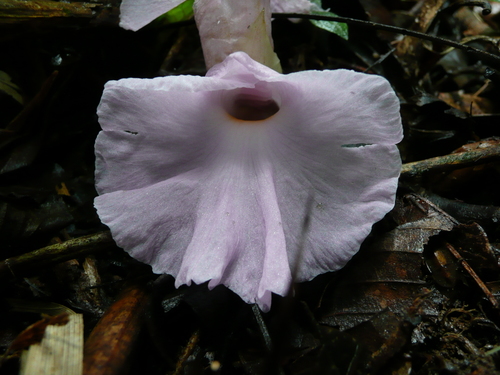
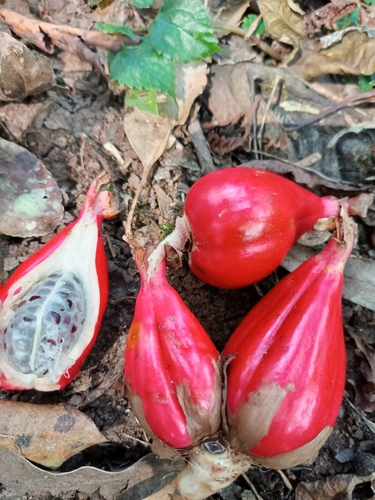
A ginger herb. The rhizomes are white. The false stems are 1-1.5 m tall. The leaves are narrowly sword shaped and 25-35 cm long by 3-6 cm wide. The flowering shoot arises from the rhizome. The bracts are red and the flowers are white with some purple and brown stripes.
Names & Synonyms
Zingiber didymoglossa K. Schum.Zingiber didymoglossum K. Schum.Zingiber emeiense Z.Y. ZhuZingiber hupehense Pamp.Zingiber liangshanense Z. Y. Zhu
References (2)
- Liu, Yi-tao, & Long, Chun-Lin, 2002, Studies on Edible Flowers Consumed by Ethnic Groups in Yunnan. Acta Botanica Yunnanica. 24(1):41-56
- Luo, B., et al, 2019, Wild edible plants collected by Hani from terraced rice paddy agroecosystem in Honghe Prefecture, Yunnan, China. Journal of Ethnobiology and Ethnomedicine 15:56