Lepidium draba
L.
Tall witetop, Hoary cress, Whitlow pepperwort
(c) joy russell, some rights reserved (CC BY), uploaded by joy russell

(c) riverwalker232, some rights reserved (CC BY-NC)

(c) Conrad Altmann, some rights reserved (CC BY), uploaded by Conrad Altmann
What to Eat
Edible parts: Leaves, Seeds
The leaves are eaten raw in salads or cooked, and are fried with eggs. The seeds are also edible. The plant is sold in local markets.
Where to Find It
It is a temperate plant. In Argentina it grows from sea level to 2,600 m above sea level.
Africa, Argentina, Armenia, Asia, Australia, Britain, Canada, Caucasus, Chile, Europe, India, Ireland, Italy, Mediterranean, Mexico, New Zealand, North America, Pakistan, Sicily, South Africa, South America, Tasmania, Turkey, Türkiye, Uruguay, USA,
How to Identify
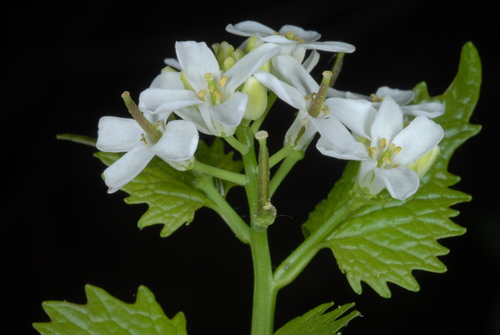
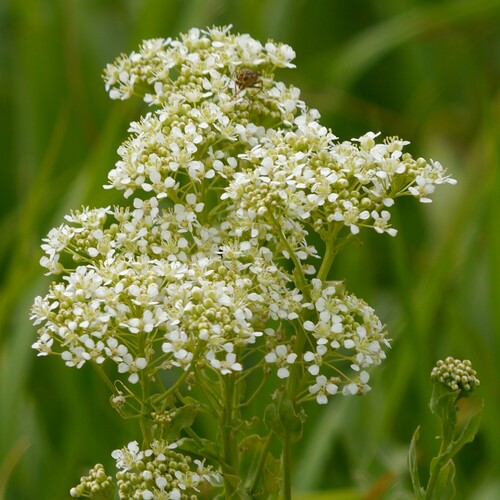
A cabbage family herb. It keeps growing from year to year. The leaves are oblong and pale grey-green. They are 3-10 cm long by 1-4 cm wide. They have small teeth and curved spines. The flowers are small and white in dense clusters.
How to Grow
It can spread by seeds or rhizomes.
Wikipedia
Source ↗Lepidium draba, also known as whitetop, hoary cress, or Thanet cress, is a rhizomatous perennial flowering plant in the family Brassicaceae. It is native to western Asia and southeastern Europe and has been widely introduced elsewhere.
Other Information
It is sold in local markets.
Names & Synonyms
Bashka, Dadhwal, Ghora wal, Ghurghwast, Khruk, Kineber, Kinevre, Kiniberk, Kinnibre, Koori sana, Paron banjar, Pepper cress, Qineber, Qunebark, Senna, Suchi senna, Thanetweed, Xardal, Xerdil
References (14)
- Demir, I. & Ayaz, N., 2022, Wild edible plants contributing to the traditional foods of Mardin (Turkey) Province. Indian Journal of Traditional Knowledge Vol 21(3), July 2022, pp 569-582
- Ertug, F, Yenen Bitkiler. Resimli Türkiye Florası -I- Flora of Turkey - Ethnobotany supplement
- Farooq, S., et al, 2012, Ethnobotanical Studies of the Flora of Tehsil Birmal in South Waziristan Agency, Pakistan. Pak. J. Weed Sci. Res. 18(3): 277-291
- Irving, M., 2009, The Forager Handbook, A Guide to the Edible Plants of Britain. Ebury Press p 93
- Kaya, O. M., et al, 2020, An ethnobotanical research in Sanhurfa central district and attached Villages (Turkey). Indian Journal of Traditional Knowledge. Vol. 19(1) pp 7-23
- Khalid, N., et al, 2023, Wild food plants gathered by four cultural groups in North Waziristan, Pakistan. Genet Resour Crop Evol. 70:1243–1276
- Majeed, M., et al, 2021, Gathered Wild Food Plants among Diverse Religious Groups in Jhelum District, Punjab, Pakistan. Foods 2021, 10, 594.
- Nanagulyan, S., et al, 2020, Wild plants and fungi sold in the markets of Yerevan (Armenia). Journal of Ethnobiology and Ethnomedicine 16:26
- Pasta, S., et al, 2020, An Updated Checklist of the Sicilian Native Edible Plants: Preserving the Traditional Ecological Knowledge of Century-Old Agro-Pastoral Landscapes. Frontiers in Plant Science. Volume 11|Article 388
- Sulamain, N., et al, 2023, The Importance of Becoming Tamed: Wild Food Plants as Possible Novel Crops in Selected Food-Insecure Regions. Horticulturae 2023,9,171.
- Wiersema, J. H. & Leon, B., 2013, World Economic Plants. A Standard Reference CRC Press. 2nd Ed. p 396
- World Checklist of Useful Plant Species 2020. Royal Botanic Gardens, Kew
- Yesil, Y., et al, 2019, Wild edible plants in Yeşilli (Mardin-Turkey), a multicultural area. Journal of Ethnobiology and Ethnomedicine (2019) 15:52
- Yesil, Y., et al, 2019, Traditional knowledge of wild edible plants in Hasankeyf (Batman Province, Turkey). Acta Societatis Botanicorum Poloniae. 88(3):3633